



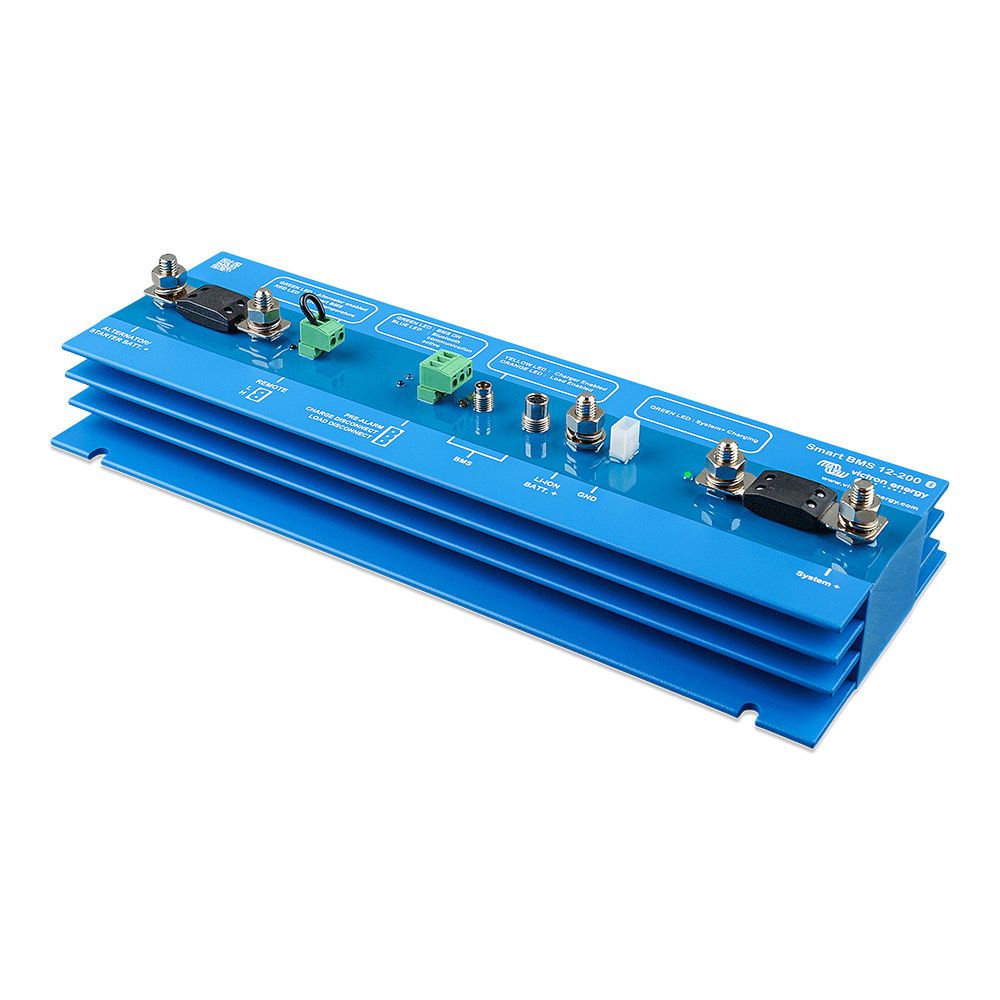
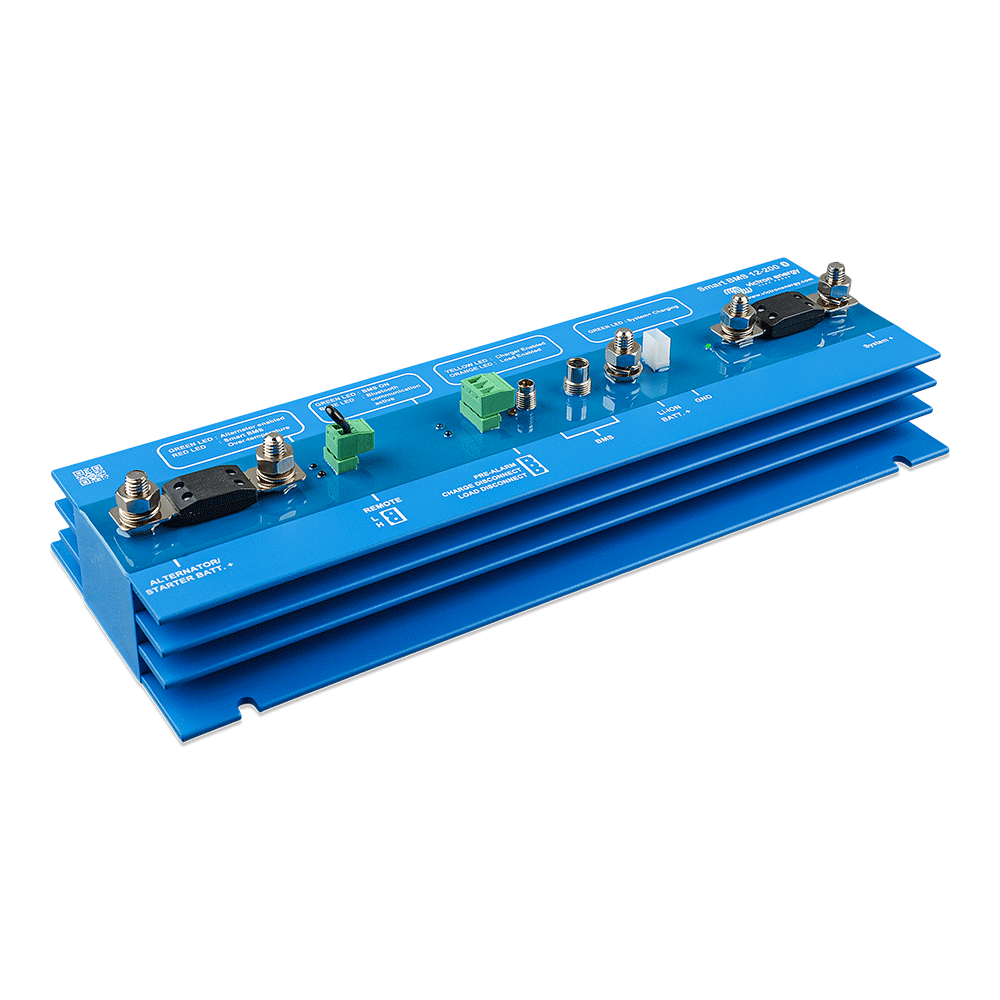

Victron Smart BMS 12/200 - Battery Management System for Lithium Batteries
Victron Battery Management System 12/200 - Smart BMS for LiFePO4
- The BMS is connected to 12.8 V Victron LiFePO4 (LFP) batteries.
- Up to 5 batteries can be connected in parallel.
- Can be used as the system's on/off switch.
- Safe and efficient charging of high-performance batteries
- No relays, but MOSFET switches, and therefore no sparking.
Tax included. Shipping calculated at checkout
Your legal guarantee rights

Product description
Victron Battery Management System 12/200: BMS for Smart Lithium-Ion Batteries
The Smart BMS 12/200 is a complete battery management system for Victron's smart lithium iron phosphate (LiFePO4) batteries. It was specially developed for 12 V systems with a 12 V alternator, e.g. for vehicles and boats.
It combines a current limiter, a battery combiner and battery protection in a robust and compact solution, and enables the safe connection of 12 V alternators (and starter batteries), loads and chargers to smart lithium batteries of any size.
The Smart BMS 12/200 monitors and protects every individual battery cell within the battery (or battery bank) and disconnects the alternator, the charging sources or the DC loads in the event of low battery cell voltage, high battery cell voltage or overheating.
The dedicated alternator connection enables current limiting and one-way current flow from the alternator to the battery, so that any size alternator (and starter battery) can be safely connected to the smart lithium battery (or battery bank) and the starter battery is protected from excessive discharge.
The BMS is equipped with Bluetooth for monitoring and configuration; a remote on/off connection to switch off the BMS (and the system) via a remote switch; as well as a pre-alarm contact to provide a warning signal before the BMS disconnects the batteries from the system.
Alternator and battery protection
The input current is electronically limited to approx. 90% of the fuse rating. A 100 A fuse, for example, therefore limits the input current to approx. 90 A.
The choice of the correct fuse will:
- a. Protect the LFP battery from excessive charging current (important for an LFP battery with low capacity).
- b. Protect the alternator from overloading in the event of a high-capacity LFP battery bank (most 12 V alternators overheat and fail if they run at maximum power for longer than 5 minutes).
Load/battery charger output/input (SYSTEM+ power supply socket)
Through this power supply socket, the LFP battery can either be charged or discharged (i.e. via a charger, an inverter or an inverter/charger) with a maximum continuous current of 200 A in both directions.
Can also be used as a load output, so that DC loads can be connected directly to this connection. The connection is short-circuit proof with a peak discharge current of 400 A. The Smart BMS ensures that battery discharge is switched off if cell under-voltage is imminent.
The Smart BMS enables charging via this connection, but no internal charging algorithm can be applied.
Starter battery protection
This function is similar to that of a Cyrix battery combiner or Argo FET battery isolator. Current can only flow to the LFP battery if the input voltage (= voltage at the starter battery) exceeds 13 V. And no current can flow back from the LFP battery to the starter battery, thereby preventing possible damage to the LFP battery due to excessive discharge.
Remote on/off input
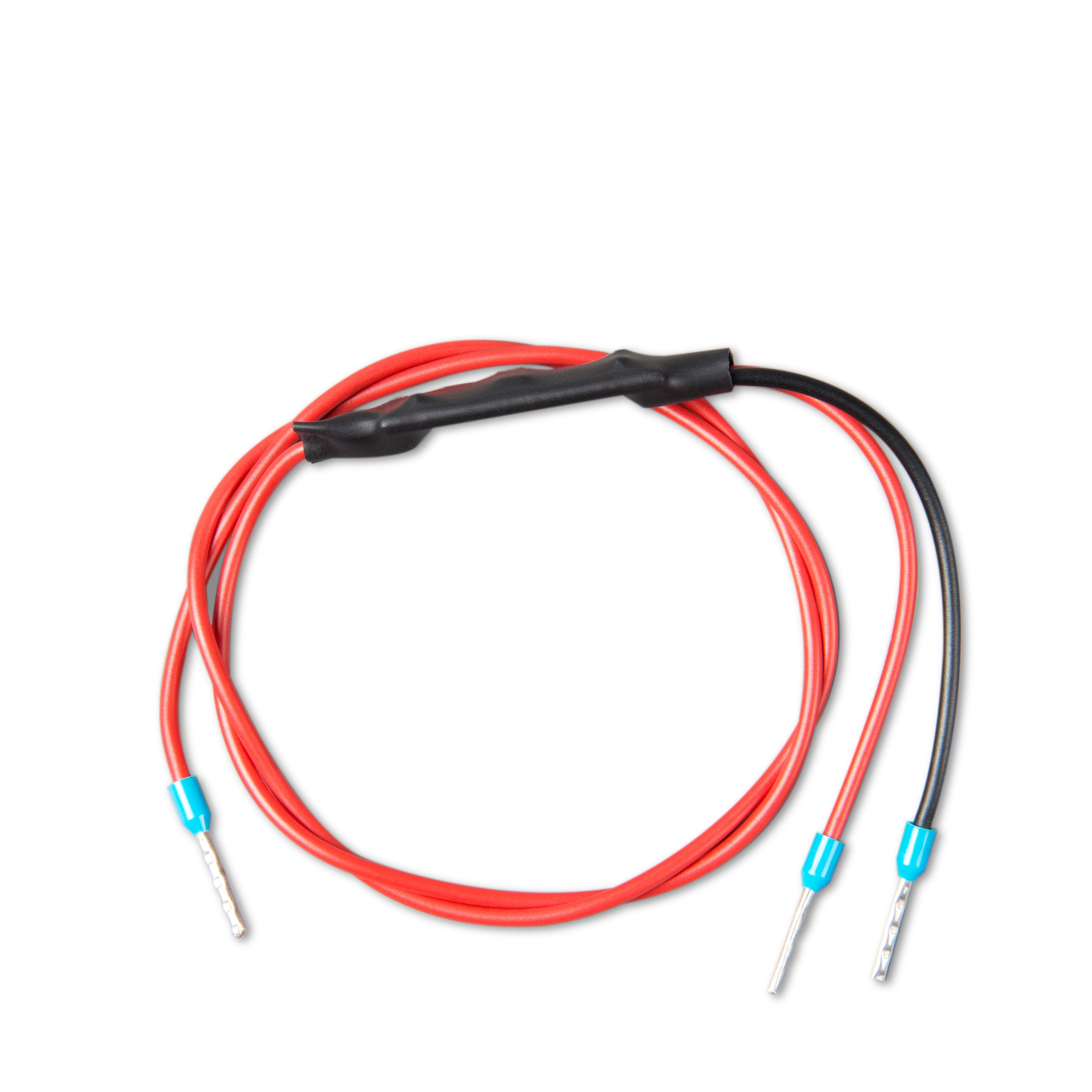
The remote-controlled on/off input controls the charging process via the alternator. In the switched-off state, charging via the alternator is deactivated, while the BMS functionality remains active, so that all loads and chargers can continue to operate regardless of the state of the remote input. If the "System on/off switch" is activated via VictronConnect, the BMS functionality is also deactivated. It consists of two terminals: Remote L and Remote H. A remote on/off switch or relay contact can be connected between H and L. Alternatively, terminal H can be connected to battery positive or terminal L to battery negative.
Product details & downloads
Manufacturer information and, if applicable, the responsible person:
Victron Energy
The Paal 35
1351 JG Almere
Email: sales@victronenergy.com
Website: https://www.victronenergy.com


Advice & Contact
Questions about the article?
If you have any further questions about the product or would like to contact us in general, please click the button and send us a message. We look forward to hearing from you!
GET ADVICE NOW