Solar panels for motorhomes – generating energy on the go
If you truly want to be self-sufficient while traveling, a well-planned solar system is essential. It's the most important energy source for campers who want to camp off-grid, travel, or spend extended periods away from campsites. A solar panel converts sunlight directly into electrical energy – quietly, reliably, and completely automatically. But which panel is right for your vehicle, your travel style, and your energy system? In this article, we'll look at all the important panel types and show you what to consider when making your selection.
We also explain the basics of module types and functionality in the topic area of solar modules .
Why is solar power so crucial?
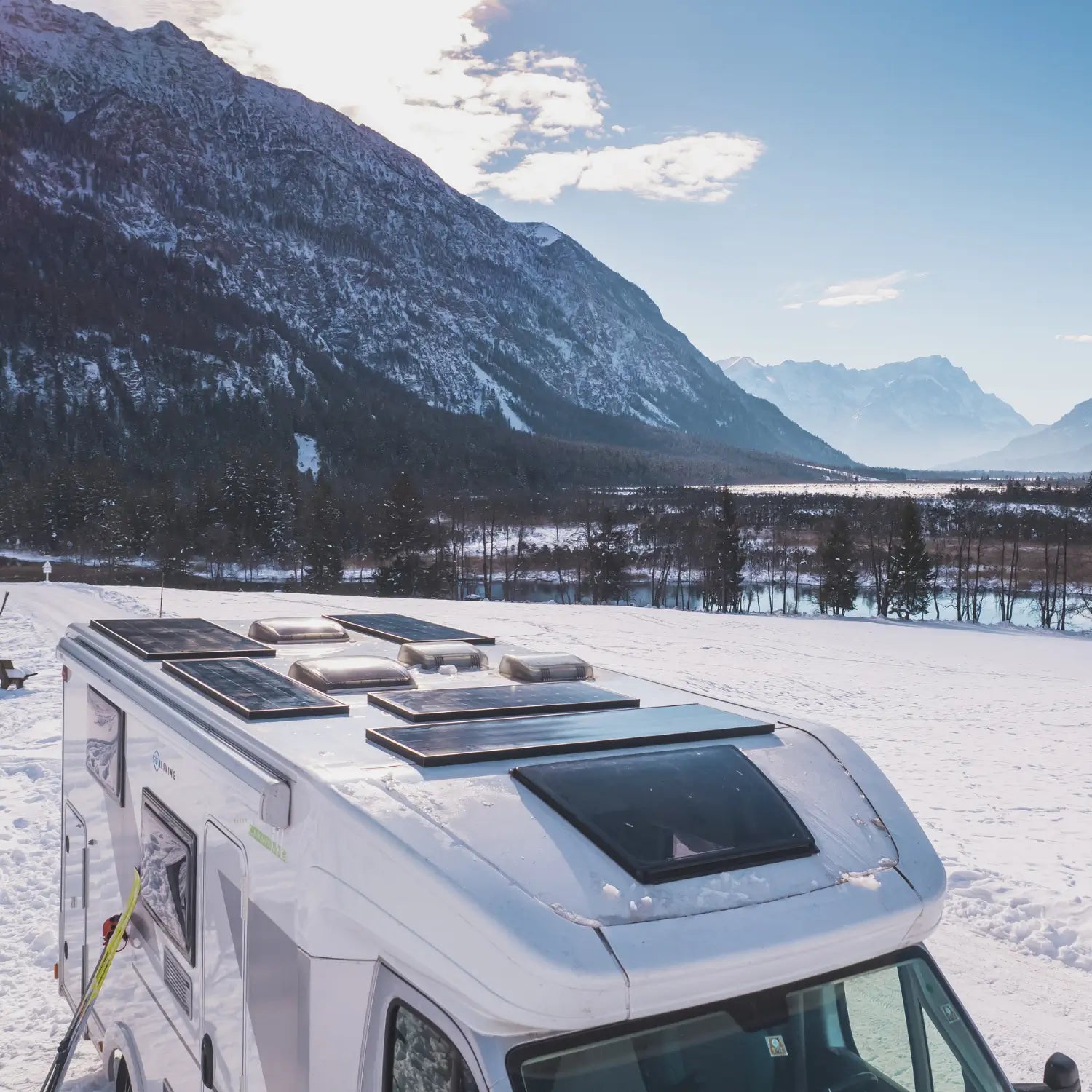
The solar system powers your entire energy supply in the camper: It charges the on-board battery, supplies your appliances and stabilizes your system – especially when you are traveling for extended periods without shore power.
In Central Europe, you can expect around 4–6 hours of sunshine per day in summer, but often only 1–2 in winter. If your system is too small, the battery won't charge fully – this leads to capacity losses in the long run and significantly reduces your comfort. However, an oversized system is equally useless if the battery is too small.
👉 The perfect solar system is created by the interplay of solar power, storage capacity and consumption.
Before we start planning, let's take a look at what types of modules are available – and which ones are suitable for your camper.
What types of solar modules are there?
Solar panels differ not only in size and power output, but also in design, weight, lifespan, and flexible use. Depending on your travel style and vehicle configuration, a different type of panel will be more suitable.
We present the most important options for campers – including specific usage recommendations.
Monocrystalline solar modules
Monocrystalline modules are the most efficient conventional, framed solar modules. They achieve high efficiencies, deliver very good performance even in direct sunlight, and require less surface area for the same wattage output.
Advantages:
- Very high efficiency
- Ideal for small roof areas
- Stable and durable
Who is it suitable for?
For campers with high power requirements and limited space on the roof – such as panel vans or vans with many roof-mounted structures.
Polycrystalline solar modules
Polycrystalline modules are classic, framed solar modules and somewhat cheaper, but less efficient. They require more surface area and deliver less power in direct sunlight than monocrystalline modules.
Advantages:
- Cheaper to purchase
- Proven technology
- Good performance under diffuse radiation
Who is it suitable for?
For vehicles with a large roof area, such as large motorhomes or expedition vehicles.
WATTSTUNDE offers various series of framed solar modules , specifically designed to meet different requirements for campers:
SOLA FRAME Mono
The Mono series is the proven classic for mobile solar systems. It utilizes highly efficient monocrystalline cells and offers an excellent balance of performance, robustness, and price. Ideal for anyone looking for a reliable, long-lasting rooftop system who wants to use their available space as effectively as possible.
SOLA FRAME Daylight
The Daylight series is optimized for maximum energy yield – even in diffuse light, cloudy skies, or unfavorable sun angles. Thanks to its particularly efficient cells, it is ideally suited for travel in regions with changeable conditions or for campers who want to maximize solar energy production even in autumn and winter.
SOLA FRAME Black
The Black series combines solid performance with a particularly discreet, black look. It is aimed at those who value a uniform, unobtrusive vehicle design without wanting to forgo the advantages of a framed solar module. Technically, it is also based on monocrystalline cells and is ideally suited for modern vans and visually sophisticated conversions.
Flexible solar modules
Flexible modules are extremely lightweight, flat, and perfect for curved roofs or vehicles with low roof load capacity. They can be glued in place, making installation particularly easy.
However, they are more sensitive to mechanical stress and have a slightly shorter lifespan.
SOLA FLEX Mono – by WATTSTUNDE
- High-quality PERC mono cells
- Up to 30% flexible
- Robust ETFE coating
- UV-resistant and saltwater resistant
- Ideal for curved surfaces and demanding outdoor applications
SOLA FLEX Daylight – by WATTSTUNDE
- SunPower cells with up to 24% efficiency
- Particularly flat and lightweight design
- Approximately 3% flexible
- UV-resistant and durable for long-term use
- Perfect for lightweight vans and nearly flat roofs
Who is it suitable for?
For anyone who wants to save weight, prefers a visually unobtrusive look, or has a curved roof.
Solar bags – maximum flexibility
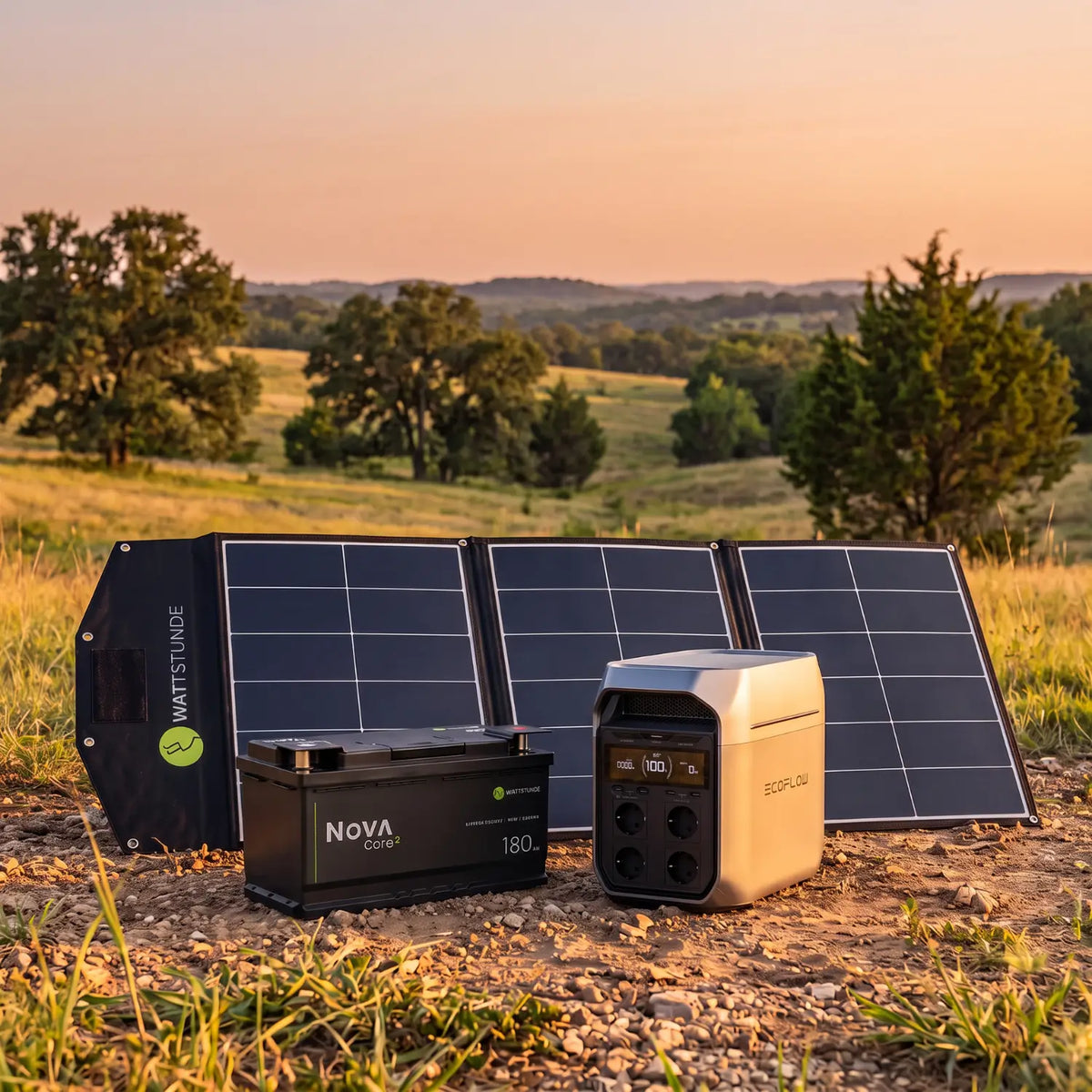
Solar bags are the most portable type of solar panel. They can be folded up and set up as needed or pointed towards the sun. This allows you to generate electricity wherever you are – without any installation.
Advantages:
- Extremely lightweight & compact
- Ready to use in seconds
- Perfect for those who park in the shade
- Ideal as an addition to the roof system
Who is it suitable for?
For anyone who travels flexibly, has little space in their vehicle, or wants to generate additional energy when needed.
Solar suitcase – mobile modules with power
Solar suitcases consist of two or more foldable, framed modules. They are more robust and powerful than solar bags, yet still portable.
Advantages:
- High performance
- Robust construction
- Free orientation to the sun
Who is it suitable for?
For travelers who want maximum efficiency without roof mounting – or for rental vehicles and off-road setups.
Overview: Comparison of solar module types
|
Module type |
Characteristics |
Suitable for … |
|
Monocrystalline |
High efficiency, durable, compact, framed solar module |
High demand & limited roof space |
|
Polycrystalline |
Affordable, robust, larger for the same performance, framed solar panel |
Budget setups with plenty of space |
|
Flexible (Mono) |
Lightweight, robust, 30% flexible |
Curved roofs, saving weight |
|
Flexible (Daylight) |
Very lightweight, SunPower cells, flat |
Lightweight vans, flat roofs |
|
solar bag |
Portable, quick to set up |
Shade parking, flexible use |
|
Solar suitcase |
Portable, high performance, robust |
Off-road, rental vehicles, additional services |
How much solar power do you really need?
The ideal solar power output depends on your consumption, battery size, and travel route. As a guideline:
|
Total performance |
Suitable for … |
|
200–300 Wp |
Mini setup, weekend trips, small consumers |
|
300–500 Wp |
Comfortable travel, refrigerator, laptop, light |
|
500+ Wp |
Full-time travel, e-bike, working in a camper van |
These values don't replace an exact calculation, but they give you a solid starting point. If you want to determine your actual needs precisely, use our solar calculator . With it, you can enter your consumption, travel habits, and planned energy independence – and receive a suitable recommendation for optimal solar power output. 👉 https://solarkontor.de/pages/solarrechner
👉 Quick tip: Before you decide on solar panels, you should be clear about how you actually travel – and where. Your personal travel style, your preferred destinations, and the time of year significantly determine how much solar power you really need. Whether you're only traveling on weekends, living full-time in a van, mostly wild camping, or traveling with family – each scenario has different requirements. Furthermore, the sun doesn't shine everywhere and at all times. In Southern Europe or during the summer, smaller systems are often sufficient, while in Central Europe during autumn or winter, you need to plan for significantly more reserves. Laptop, refrigerator, e-bike, coffee maker, or just lights and your mobile phone – every appliance changes your energy needs. Therefore, there's no one-size-fits-all solution, but rather a setup that suits you, your destinations, and your travel time.
Fixed solar panels vs. mobile solar bags
Fixed solar panels provide a constant energy supply throughout the day – without any assembly or disassembly. They are ideal if you want to generate electricity continuously and are looking for a solution that simply works once the panels are installed. They form the stable foundation of many camper systems: reliable, low-maintenance, and perfect for anyone with sufficient roof space who wants a continuous energy source.
Mobile modules, on the other hand, offer maximum flexibility. They can be freely positioned to face the sun, function independently of the vehicle's location, and are ideal for those who park in the shade or campers who frequently park in forests, cities, or under trees in the summer. You can simply place a solar panel wherever the sun is shining – while your vehicle stays pleasantly cool in the shade. Many compact models even fit on or behind the windshield, which is particularly practical when you're on the road or don't have space to set them up.
In many setups, a combination of both is the most sensible solution: Fixed roof-mounted modules reliably cover your basic needs, while a solar bag or suitcase provides additional power when the sun is low, in the shade, or when energy demands are higher. Our recommendation: Use fixed modules for continuous operation and supplement them with a portable module as needed for maximum flexibility.
Fasteners & Mounting Accessories
There are various mounting options for fixed modules:
- Mounting spoiler
- Corner profiles
- Aluminum profiles
With flexible modules, you can often completely do without screws and simply glue them together.
It is important that the modules are securely attached, do not transmit vibrations, and that the cables are routed cleanly and in a waterproof manner.
Wiring configurations: series, parallel and mixed circuits
The type of wiring affects the performance of your solar system – but don't worry: a basic understanding is perfectly sufficient for most campers.
series connection
Here, the voltage adds up, but the current remains the same. This is efficient for longer cable runs – however, the entire cable set is more sensitive to shadows.
Parallel connection
The voltage remains the same, but the current increases. This is ideal if the modules are oriented differently or if there is partial shading. For this, you usually need larger cable cross-sections.
Mixing circuit
A combination of both methods is useful for larger systems to combine efficiency and shading tolerance.
👉 If you'd like to delve deeper: We have a detailed blog article about all wiring types – including clear examples, graphics, and practical recommendations. There, we explain in detail which wiring is ideal for which application.
You can find the article here:https://solarkontor.de/blogs/news/reihen-parallel-und-mischschaltung
And you can also find a relevant video on the WATTSTUNDE YouTube channel: https://youtu.be/SWHpH3pCfu8?si=3n5pvJ4Ls4pCINMU
Conclusion & Outlook
Solar panels are the most important energy source for a self-sufficient motorhome. Whether fixed, flexible, or portable – the crucial factor is that the panel suits your energy consumption, your vehicle, and your travel habits. Plan for sufficient reserve capacity, pay attention to high-quality cells, and combine fixed and flexible solutions if you want maximum freedom.
The next part of our component guide will focus on solar charge controllers – the link between the solar module and the battery.