

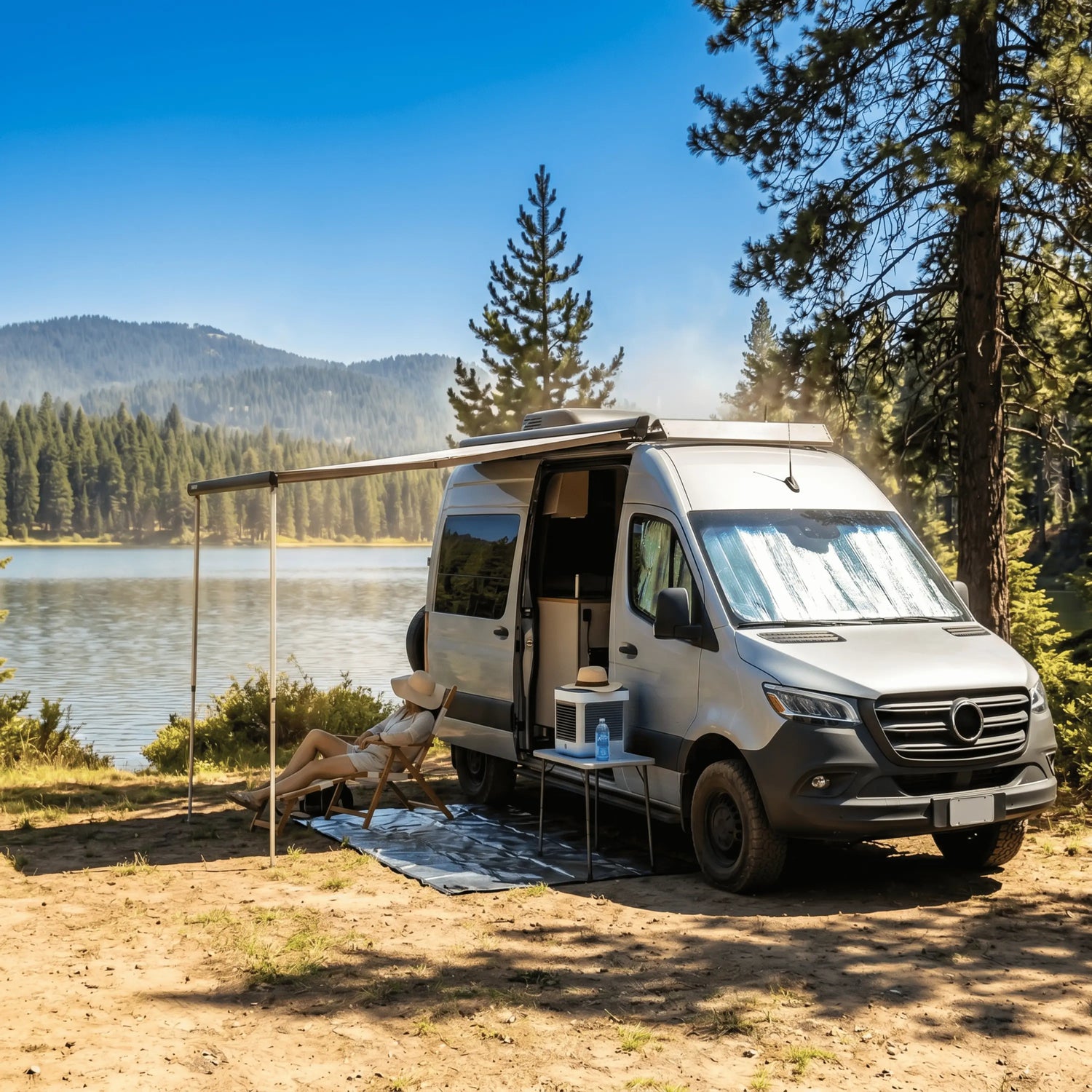
When it gets really hot for several days in a row, camping can quickly become a challenge: heat builds up in the van, the air gets stuffy in the motorhome, and you get a sauna-like feeling in the tent from 8 a.m. onwards.
The good news: You can do a lot before you even think about an air conditioner. And if you do want to cool down actively, there are solutions ranging from smart ventilation to a roof-mounted air conditioner. In this article, you'll get practical tips for hot days and suitable products that will make life on the road noticeably more comfortable.
Why heat becomes such a problem when camping
In everyday life, you can retreat from the heat: a cool room, a fan, a cold shower. When camping, however, you're often in a small space, vehicle, or tent, in the sun and with limited energy.
Typical heat sources when camping:
- Direct sunlight (windows, roof, tent fabric)
- Heat storage (bodywork, furniture, mattresses)
- Insufficient air exchange (stagnant, warm air)
- Power shortages (cooling technology cannot run continuously)
The goal is therefore always two-fold:
- Prevent heat from entering in the first place
-
Get heat out (air exchange or active cooling)
The basics: How to prevent it from getting too hot in the first place
Many people underestimate how much effect simple measures have compared to air conditioners.
Location and timing: Free heat protection hacks
- Shade is king: If possible, park so that the sunny side does not hit the large window areas directly.
- Use the wind: A campsite with a light breeze often feels 5 °C cooler.
-
Ventilate in the morning and evening, keep it sealed at noon: It sounds trivial, but it's the biggest lever. Otherwise, you're only bringing hot air into the vehicle at noon.
Blackout and shielding: Keep the heat outside
- Shading from the outside beats shading from the inside: Anything that stops the sun before it hits the glass significantly reduces heat gain.
- Don't forget the windshield: It is often the biggest radiator in the camper.
-
Textiles as heat storage: Bedding, blankets, and dark fabrics store heat. Packing them away during the day helps.
Ventilating properly: Cross ventilation instead of opening a window and hoping
A single window often does little. Better is:
- Two openings on opposite sides (cross ventilation)
- Roof opening plus side window (chimney effect: warm air rises)
Remember: Ventilation is most effective when the outside air is actually cooler than inside, so usually early in the morning and in the evening.
Health and safety: Heat is no fun, especially in a vehicle
Heat is not just about comfort. It is also about circulation, sleep, and safety.
Warning signs of heat stress
Pay attention to yourself and your fellow travelers if you notice:
- Headaches
- Dizziness
- Nausea
- unusual fatigue
- very dry mouth
Then: shade, drink, cool down, take a break. And if it gets serious: get help.
Drinking and eating: Small rules, big impact
- Drink regularly, not just when you are thirsty
- Eat light (heavy meals make many people sleepier in the heat)
- If you sweat a lot: Also think about salt and minerals
Very important: No one stays in a closed vehicle
A parked vehicle heats up extremely quickly in the sun. Please do not leave people or animals in the car or camper, even just for a short time.
Three technical ways to combat heat and which one is right for you
Now we get to the practical part: Which technology really helps and for what.
1) Active cooling: Air conditioner
If you want to work during the day, sleep poorly at night, or generally react sensitively to heat, active cooling is often the game changer.
Important: An air conditioner is not just nice to have, but a real comfort and sometimes also health solution, but it needs a sensible power base.
Roof-mounted air conditioner in the camper: Comfort solution with clean integration
If you want a permanently installed solution, roof-mounted air conditioners are often the best option:
- Bergstrom OpenAir Roof-Mounted Air Conditioner 12 V Full Inverter: A 12-volt roof-mounted air conditioner, exciting for setups that rely on a clean onboard electrical system.
- Bergstrom OpenAir Plus Roof-Mounted Air Conditioner: Also designed as a roof-mounted air conditioner, ideal if you prefer a fixed, integrated solution.
Portable air conditioner: Flexible if you don't want to install it permanently
You don't want to retrofit a roof-mounted air conditioner or want to stay flexible, also for a tent, awning, or small vehicles. Then a portable solution can make sense.
- EcoFlow WAVE 3 portable air conditioner: A portable air conditioner that scores points especially when you are looking for a flexible cooling option.
Practical tip: Whether roof-mounted or portable air conditioner: The less heat gets into your vehicle in the first place, the easier it is to cool. Use blackout during the day and preferably exterior shading, so that the interior does not heat up so much in the first place. This saves power and makes the difference.
2) Air exchange instead of cold: Solar fan against heat buildup and stuffy air
You don't always need real cold. Often it is enough to get the warm air out before it settles in the interior.
Solar fans are particularly interesting if you:
- stand around a lot during the day and your vehicle heats up
- want to get fresh air in quickly
- are looking for a solution that works without continuous power consumption from the leisure battery
WATTSTUNDE® AERO solar fan: Two variants for different installation situations
What you should expect: A fan does not replace an air conditioner if you want real cooling in the shade at 35 °C. But it can noticeably improve the interior climate because the air stays in motion and heat and moisture are transported away.
3) Stay cool by cooling well: Cooler box and compressor cooler in the heat
Heat is not just too warm for sleeping. It is also an issue for food and drinks.
- Drinks quickly become lukewarm
- Food spoils faster
Here, powerful cooling can bring a lot of comfort.
EcoFlow GLACIER Classic 35 l: Comfort for summer
- EcoFlow GLACIER Classic 35 l: Exciting if you are looking for a serious cooling solution for warm days.
Practical tip: Do not place your cooler box in the direct sun and open it as rarely as possible. Every opening is like leaving the door open in the refrigerator at home, only that outside it is not 22 °C, but 32 °C.
When the leisure battery is empty
At the latest in the heat you will notice: cooling technology is great, but power is the foundation. Especially devices like an air conditioner are among the major consumers and draw a lot of energy depending on the model and operating time.
Power backup when the leisure battery is empty: Powerstation plus feed-in cable
When the leisure battery is empty, you don't have to shut everything down immediately. A really practical solution, especially for rental campers or for setups without a fixed retrofit: You use a Powerstation as an energy storage and feed it back into the vehicle via a CEE feed-in cable with RCD. This way you can power your consumers again and stabilize your onboard energy.
Important: Make sure that the feed-in fits your vehicle and your setup and use the protection function.
Mini checklist: Your heat day in the camper (2 minutes)
If you only have two minutes before the day gets really hot, a small routine is often enough. This mini checklist helps you avoid the biggest heat traps and quickly set your setup to summer mode.
- Ventilate early, then blackout
- Refill water, plan light snacks
- Ensure air exchange (cross ventilation, roof opening)
- Cooler box in the shade, reduce openings
- Check power: What runs when and for how long
Staying cool is manageable
Extreme heat when camping is exhausting, but you are not helpless against it. If you start with location, blackout, and clever ventilation, you have already gained a lot. For the next step, there are two strong ways: air exchange (e.g. via solar fan) or active cooling (portable or as a roof-mounted air conditioner). And so that you don't run out of juice on the road, a plan for shore power or a Powerstation is worth it.
We are happy to help you find the right solution for your camping style, so that summer remains exactly what it is meant to be: Your outdoor adventure.