

A reliable power supply is essential when traveling – whether for the refrigerator, laptop, or other 230V devices in the campervan. Many campers rely on a power station to remain flexible even without access to mains electricity. However, connecting a power station to the campervan poses safety risks if the residual current device (RCD) is not functioning correctly.
The WATTSTUNDE® CEE power supply cable with RCD This allows you to safely and compliantly supply 230V power from your power station to your motorhome . Thanks to the integrated residual current device (RCD), it reliably protects you and your devices from fault currents and ensures a stable connection. The power station remains outside the vehicle , while you can safely use the power inside your motorhome.
For whom is the WATTSTUNDE CEE power supply cable with RCD suitable?
The WATTSTUNDE® CEE power supply cable with RCD is ideal for anyone who uses a power station and relies on a safe 230V power supply in their motorhome.
It is particularly suitable for:
- Campers who want to use their power station as the main power source in their motorhome
- Motorhome owners who want to safely feed electricity from a power station into the grid
- Anyone who needs a reliable connection to the CEE socket without the risk of fault currents
⚠ Important note: The power station must not have an activated PEN bridge on the output. (e.g. EcoFlow Delta Pro 3, where the grounding is switchable).
This feed-in cable is not needed for power stations like the EcoFlow Delta Pro 3, as they are already designed for safe power feed-in.
The cable is specifically designed for caravans, motorhomes and campervans and is not suitable for boats.
Differences between shore power and power stations
Power stations and shore power grids operate with different electrical systems:
- Shore power (TN network): A permanently grounded network available at motorhome pitches or campsites. Residual current devices (RCDs) function reliably here.
-
Power station (IT network): An isolated network without a fixed earth connection. A conventional residual current device (RCD) cannot trip correctly in this network.
In an IT network, there is no fixed earth connection, which is why a conventional residual current device (RCD) cannot detect a difference. The CEE inlet cable with integrated RCD ensures that the protection mechanism still functions and that the system reliably shuts down in the event of a fault.
This means that if you simply connect a power station to the CEE power inlet socket, protective mechanisms can be bypassed. Fault currents then go undetected, which poses a potential danger.
When does a potential danger exist?
A hazard arises when a fault current occurs and is not detected or switched off . This can happen in the following cases:
- Defective appliances: An insulation fault (e.g., in a coffee machine) can cause the casing to become live. Without grounding, the fault current cannot dissipate – an electric shock is possible.
- Touching a live wire: If a damaged cable is touched, electricity can flow through the body. Since the power station is not grounded, the residual current device (RCD) will be ineffective.
- Moisture or leakage currents: Water in sockets or devices can lead to uncontrolled leakage currents. In a TN network, the residual current device (RCD) would trip – in an IT network, the fault current often goes unnoticed.
The CEE power supply cable with RCD ensures that the RCD protection works reliably and that your power station can safely feed power into the motorhome.
How the residual current circuit breaker (RCCB) increases your safety
A residual current device (RCD) monitors the current flow and detects when electrical energy escapes in an unwanted way – for example, through a faulty appliance or the human body. In this case, it interrupts the circuit within milliseconds, thus preventing dangerous electric shocks and potential damage.
Because a power station operates with an isolated IT network , a standard residual current device (RCD) typically cannot trip. The WATTSTUNDE CEE power supply cable with integrated RCD solves this problem by adapting the power station's network structure to ensure proper RCD protection.
This gives you the same level of safety as when using regular shore power.
Simple and safe application
The WATTSTUNDE CEE power supply cable with RCD has been designed for easy and quick use:
- Connecting the power station: Connect the Schuko end (male) to the socket of your power station.
- Use a CEE socket: Plug the other end (female) into the CEE power inlet socket of your motorhome.
- Activate residual current device (RCD) protection: The integrated residual current circuit breaker (RCCB) now ensures that fault currents are detected and switched off.
Important:
✅ Use only with a power station!
❌ Do not connect the power station to shore power at the same time!
Why? Because shore power uses a fixed earthing system (TN network), while the power station uses an isolated network (IT). Connecting them simultaneously can cause problems with the protective tripping mechanism. If both networks are connected at the same time, the earth potential difference can cause problems. Uncontrolled currents can be generated between the two systems. These can lead to:
- The residual current device (RCD) of the shore power supply trips unexpectedly because it measures unexpected currents.
- The RCD of the power station is not working correctly because the IT network does not have a fixed ground and therefore fault currents are not detected properly.
Why the power station should be operated outside the motorhome
 For safety reasons, we recommend operating the power station outside the motorhome . This minimizes the risk from exposed electrical contacts and ensures reliable residual current protection.
Anyone who still wishes to use the power station indoors must take additional protective measures and consult a qualified electrician .
Always have safety-relevant installations carried out by a professional to avoid risks!
Using a power station with solar charging
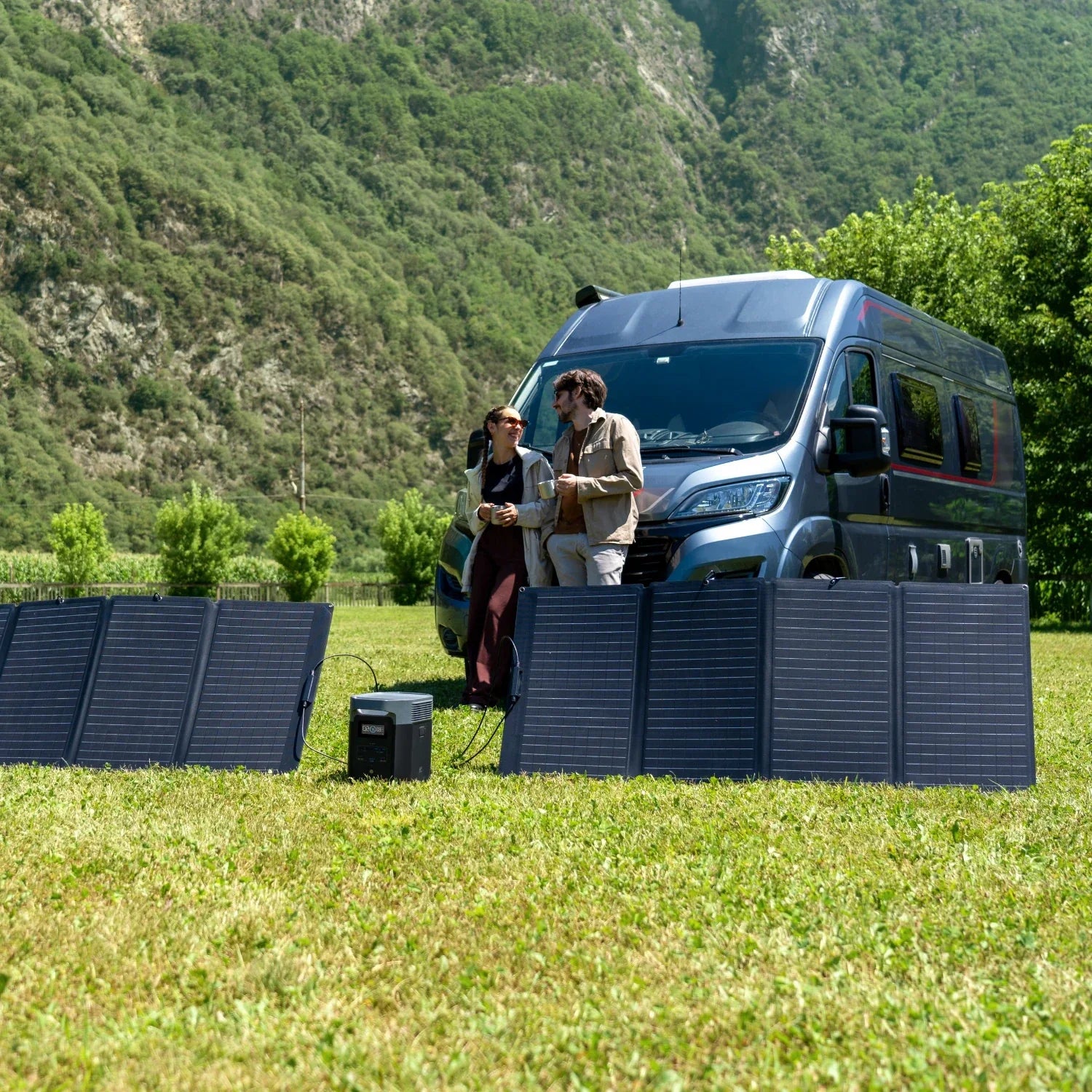
A power station can be charged simultaneously with solar power while supplying electricity to the motorhome. This is particularly useful for remaining more independent from external power sources while traveling.
But be careful: The power station must not be connected to shore power at the same time!
With a combination of power station, CEE feed-in cable with RCD and solar charging, you have a flexible and safe power solution for your motorhome.
12V vs. 230V systems in motorhomes
Many motorhomes use both 12V and 230V power systems . But what are the differences, and how can a power station be safely integrated into a motorhome?
12V systems – Safe, but limited
- They operate directly via the vehicle's battery.
- Ideal for LED lighting, USB devices and small consumer devices
- No residual current device (RCD) is necessary , as there is no dangerously high voltage.
12V systems are energy-efficient and safe, but are not sufficient for many devices.
230V systems – More comfort, but with safety requirements
- Required for household appliances such as coffee machines, laptops or microwaves
- Can be powered by shore power or a power station
- Residual current device (RCD) protection is mandatory for safe power supply to the motorhome.
How does the power station fit into the motorhome's electrical system?
If you want to use a power station as a 230V source , you can do so with the WATTSTUNDE CEE feed-in cable with RCD. Connect it to the CEE power inlet socket of your motorhome. The cable ensures that the Safety mechanisms function correctly and the power supply complies with VDE standards .
- Without the correct power supply cable, there is a risk that the residual current device (RCD) will not trip and fault currents will go unnoticed.
- With the WATTSTUNDE CEE feed-in cable with RCD, the residual current protection is activated, so that your motorhome can be operated safely as with shore power.
Anyone wanting to use 230V from a power station in their motorhome should ensure a safe power supply. The WATTSTUNDE CEE power supply cable with integrated residual current device (RCD) ensures that fault currents are detected and interrupted, guaranteeing a safe and compliant 230V supply for your motorhome.
Which power stations are suitable for the WATTSTUNDE CEE feed-in cable with RCD?

Power stations from manufacturers such as: are particularly well suited.
- EcoFlow
- Jackery
- Bluetti
- anchor
These brands offer reliable power stations with sufficient power for supplying electricity to a motorhome. Important: The power station must have a Schuko socket (EU plug, 230V output, 50 Hz) so that the power supply cable can be connected.
This cable is not suitable for power stations with only DC outputs (12V/USB) or special US-style outlets. If you are unsure whether your power station is compatible, check the technical specifications or contact the manufacturer directly.
Safe power feed-in with the right technology
The WATTSTUNDE CEE feed-in cable with RCD offers you a simple, safe and standards-compliant way to feed power from a power station into your motorhome.
- Safe 230V power supply from a power station
- A residual current device (RCD) provides protection against fault currents.
- Easy application without modifications to the motorhome
- For motorhomes and caravans
Anyone who wants to operate a power station in their motorhome should rely on a safe power supply – with the CEE feed-in cable with RCD from WATTSTUNDE.