

Balcony Solar Calculator: Calculate Savings and Payback Period
With the balcony power plant calculator, you can find out what power is right for your electricity consumption , how much you can expect to save per year, and when the purchase will pay for itself.
Simply enter your annual consumption, electricity price, location, module orientation, and usage profile. The calculator will then match your requirements to an available power class and guide you to the right balcony power plant kit.
Which service is right for you?
Answer 3 questions – we’ll recommend the right system size for you.
How much do you save per year?
Your annual savings based on your electricity price.
When is it worth it?
Your personal payback calculation – based on the information you provided.
Alle Angaben sind Richtwerte auf Basis regionaler Einstrahlungsdaten und typischer Nutzungsprofile. Tatsächliche Erträge können je nach Wetterjahr, Verschattung und individuellem Verbrauchsverhalten abweichen (±10–15 %). Keine Gewähr für die Richtigkeit der Berechnungen.
How does the balcony power plant calculator determine the recommendation?
The calculator combines your estimated electricity consumption with typical solar radiation values for the selected region, the module orientation, your electricity price, and your usage profile. This results in a power recommendation, an estimated annual saving, and a model payback period.
The set recommendation is based on the available power classes in our shop. Therefore, the recommended set may differ slightly from your calculated requirements. The calculator assigns the requirements to the next closest available class.
Calculate balcony power plant payback
The payback period describes the time after which the calculated expected savings equal the purchase costs. The calculation takes into account the price of the selected set, the annual savings, and the assumed electricity price increase.
The result is a guideline and not a guarantee. Actual savings depend on, among other things, on the weather, shading, electricity consumption, self-consumption, and the technical characteristics of the set.
Calculate balcony power plant with storage
A storage system can store solar electricity and make it available later when the modules are not currently generating electricity. This can change the proportion of self-consumed solar electricity.
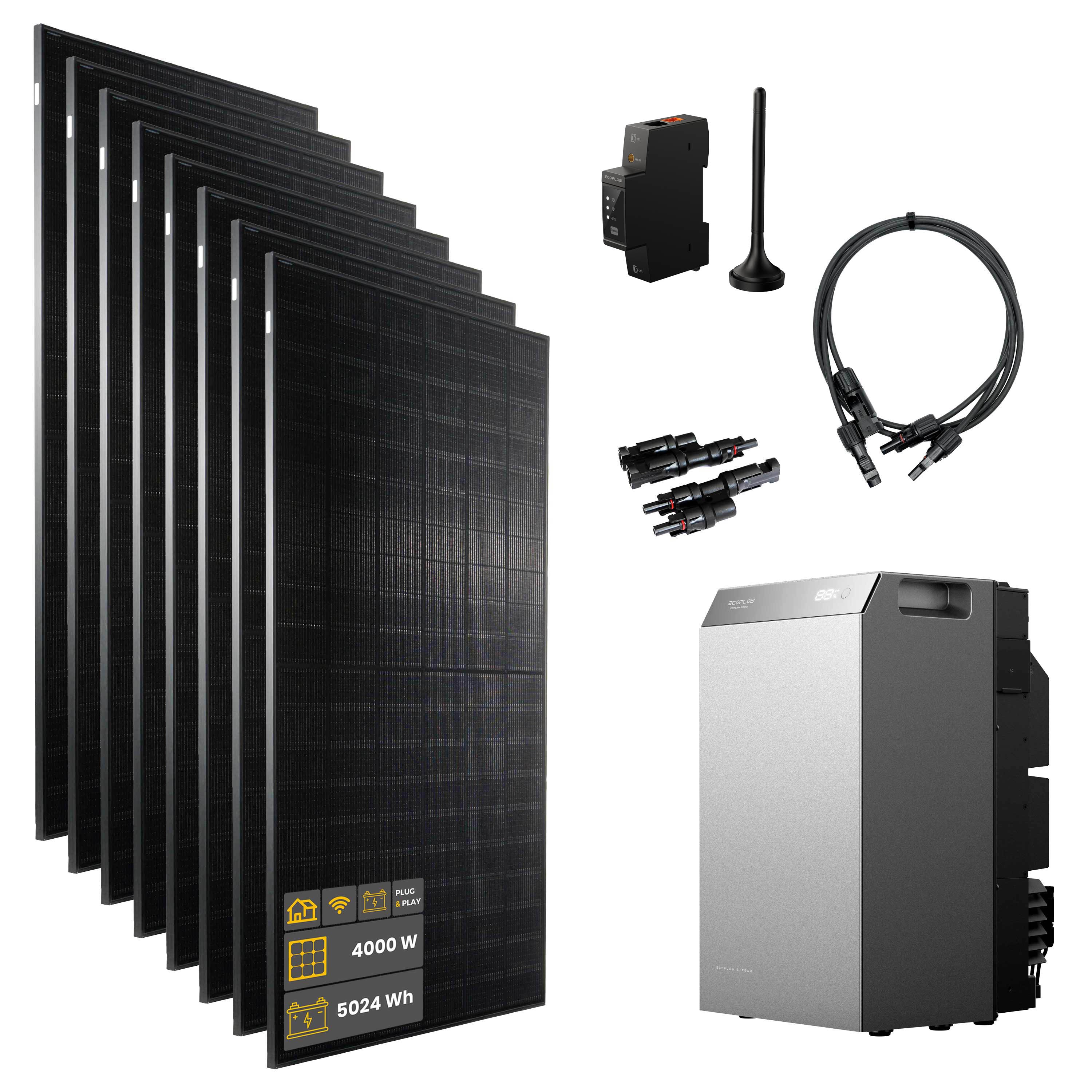
Whether a storage system is economically viable depends on your consumption profile, your presence during the day, the set price, and the actual usage. Therefore, you can directly compare the 1000-W variant without storage with the variant with storage in the calculator.
Frequently Asked Questions about the BKW Calculator
You’ve done the math—now come the questions. Here you’ll find answers about accuracy, set recommendations, and everything else still up in the air before you buy.
The calculator provides sound estimates, not exact guarantees. The results are based on regional solar radiation data, typical usage profiles, and a performance ratio of 0.80. Deviations of ±10–15% are realistic, depending on weather conditions, shading, and actual consumption patterns.
A balcony solar system pays for itself once the cumulative electricity cost savings equal the purchase price of the set. How long this takes depends primarily on the following factors:
- Purchase price of the set
- System capacity
- Location and orientation of the panels
- Annual electricity consumption
- Actual self-consumption
- Electricity price
- Additional storage and its cost
Our calculator uses this information to estimate the payback period in years. The result is a guideline, as weather, shading, and individual consumption patterns can affect the actual savings. A set with storage may initially have a longer payback period due to the higher purchase price, but may also enable higher self-consumption.
BKW sets are available in fixed power classes—not in just any Wp value. The calculator automatically recommends the closest matching set from our range. Slight over- or under-dimensioning is normal and usually has a negligible economic impact.
Yes – especially if you are out of the house during the day. Without storage, some of the electricity generated is fed into the grid unused. With storage, you can also use excess solar power in the evening and at night, significantly increasing your self-consumption.
A balcony power plant (up to 800 W inverter power / 2000 Wp module power) must be registered in the Federal Network Agency's Market Master Data Register (MaStR). A separate registration with the grid operator is generally no longer necessary since the Solar Package I (May 2024), as the data is automatically transmitted from the MaStR. Registration is free of charge and usually takes only a few minutes. An electrician is normally not required for plug-and-play systems within the power limits (observe VDE guidelines, especially with higher module power).
That depends on the respective set. Many of our STREAM sets are modular – you can add more modules or storage later. The product details of the recommended set will show you which options are available.
