


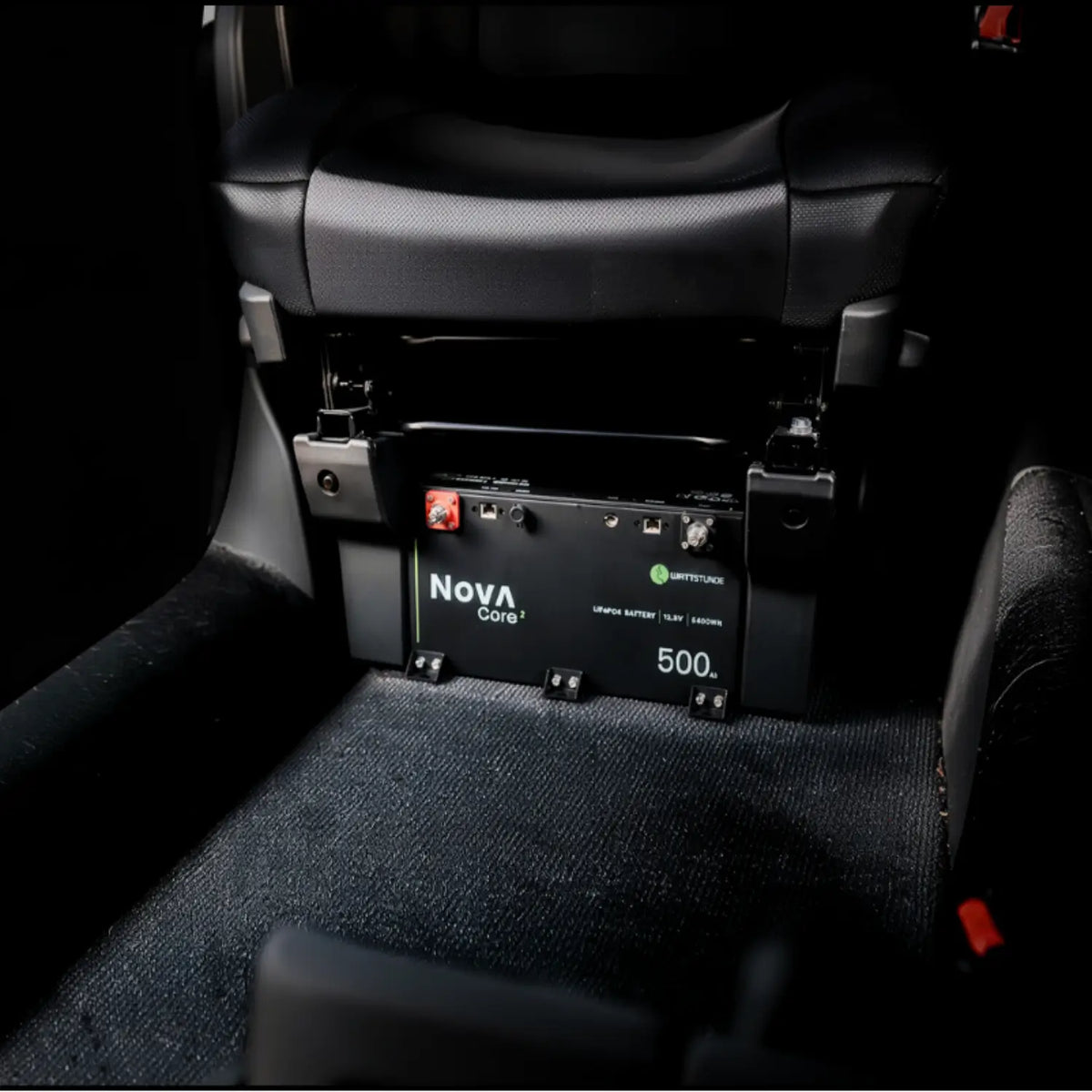
When every centimeter counts in a camper, the space under the seat quickly becomes a secret weapon. This is where the under-seat battery comes into play: you get a lot of capacity in an area that often remains unused. The result is a tidy power setup, greater self-sufficiency, and usually shorter cable runs.
In this article, you will learn what really matters with an under-seat battery: you will learn how to measure the seat box correctly, which batteries fit under the seat, and what is important during installation to ensure that everything runs safely and reliably in the end.
What is an under-seat battery?
An under-seat battery is a leisure battery installed in the seat box or seat console under the driver or passenger seat. This allows you to use existing structural space without losing living area storage space.
Why an under-seat battery is so popular
The biggest advantage is quite simple: space savings. Storage space is always limited in a camper, and a battery in the seat box disappears exactly where it won't bother anyone. At the same time, the weight is positioned low in the vehicle, which often feels positive in terms of handling.
In addition, there is a practical effect during installation: if your battery is located close to the distribution panel, charge booster, or inverter, cable runs are often shorter. Shorter cable runs mean less voltage drop and less effort during installation.
Will the under-seat battery fit under your seat?
Please measure before purchasing. Seat consoles and seat frames vary depending on the vehicle model, year of manufacture, and version, so a battery will not automatically fit under the seat in every vehicle.
Checklist: how to properly check the seat box
To ensure that you not only get the battery in but can also connect it neatly later, follow this order:
- Take internal measurements: length, width, and height in the seat box
- Plan space for connections: terminals, cable lugs, and cable bending radius
- Check for obstacles: struts in the seat frame, cable ducts, and existing components
- Consider service access: can you still reach the fuses and connections
- Compare data sheets: match the dimensions and terminal position with the manufacturer's specifications
If you notice during measuring that things are really tight, always plan some reserve. A few millimeters can ultimately determine whether you can install the battery stress-free or whether it will bump into struts or edges during installation.
What to do if it barely fits
Sometimes the battery itself is not the problem, but the surrounding area. Typical obstacles are cross struts, a swivel console, or cables located exactly where the battery is supposed to go. In such cases, there are often three clean solutions.
- You choose a more compact version that fits better in the seat box.
- You relocate components that are in the way, provided this is technically sensible and permitted.
- You check in advance whether adjustments to the seat frame are possible on your vehicle.
These batteries fit as under-seat batteries
The goal is always the same: maximum capacity in a small space. The key is to choose the combination that fits in your seat box and matches your power requirements.
The following batteries fit under the seat:
The following batteries fit under the seat: 1x or 2x NOVA Base 2 60Ah 1x or 2x NOVA Base 2 100Ah 1x or 2x NOVA Core 2 100Ah 1x or 2x NOVA Core 2 150Ah 1x or 2x NOVA Core 2 180Ah
*1x NOVA Core 2 320Ah
*1x NOVA Core 2 500Ah
*Please check before purchasing whether the battery fits your vehicle. Some vehicle models may require adjustments to the seat frame.
Table: quick overview by capacity and use
The table helps you roughly categorize the models by usage profile. However, for the final decision, you must still check the space and realistically estimate consumption.
|
Model |
Capacity |
Typical use |
Recommended if you |
|
NOVA Base 2 60Ah |
60Ah |
use compact basic power |
for lights, water pump, USB, and small appliances |
|
NOVA Base 2 100Ah |
100Ah |
want a solid start with reserves |
are regularly on the road and want a larger buffer |
|
NOVA Core 2 100Ah |
100Ah |
want more performance in the system |
draw higher currents or integrate more technology |
|
NOVA Core 2 150Ah |
150Ah |
want more autonomy per battery |
want reserves even in bad weather |
|
NOVA Core 2 180Ah |
180Ah |
want a powerful under-seat battery solution |
are often off-grid and use larger appliances |
|
NOVA Core 2 320Ah |
320Ah |
want a lot of capacity in a compact package |
are planning a large setup but only have one space |
|
NOVA Core 2 500Ah |
500Ah |
want maximum autonomy in the seat box |
want to stay off-grid for long periods and need a lot of energy |
1x or 2x under-seat battery: which combination is right for you
One battery is often the simplest solution. Two batteries make sense if you need more capacity and the seat box has enough space.
When deciding between 1x and 2x, follow a simple logic: first determine your consumption, then check the space, and finally choose the capacity. This will prevent you from buying a lot of energy that you cannot store effectively.
Practical orientation by travel profile
|
Your travel profile |
Typical use |
What matters for the under-seat battery |
|
Weekend trips |
Lights, charging, water pump, short periods |
compact, simple, quick to install |
|
Comfort setup |
more electronics, more frequent off-grid use |
reserves in Ah, stable installation |
|
Long periods off-grid |
high energy demand, possibly an inverter |
large capacity, suitable cables and fuses |
Installation and safety: how to keep your under-seat battery reliable
The installation determines whether you will have peace of mind later. Cable cross-section, cable length, and fuses must match the maximum current so that the system can be operated safely.
Properly plan cables and fuses
An under-seat battery can deliver very high currents, especially if you are operating an inverter or powerful chargers. That is exactly why you should not choose cables and fuses based on guesswork.
It is important that the cross-section, cable length, connection points, and pre-fuses match the maximum charging and discharging current. If you are unsure, use our calculator and plan properly rather than dealing with warm cables or voltage drop later.
Here is our cable calculator: https://solarkontor.de/pages/kabelrechner
Mounting in the seat box
Even if the battery is stationary during everyday use, it must be securely fixed mechanically. In the event of sudden braking, nothing must move. Also, make sure that no sharp edges rub against the cables and that the terminals are protected against accidental contact.
Access for maintenance and inspection
It is often cramped under the seat. Therefore, plan so that you can still reach the fuses, connections, and any existing switches. This will save you time later if you want to check or modify something.
Charging and integration into the power system
The under-seat battery is just one component. For it to work in everyday use, solar, shore power, and the alternator must interact properly with it.
Sensibly combine solar, shore power, and the alternator
In a camper, you typically have three charging sources.
Solar charges during the day and is ideal for long periods off-grid. Shore power is the convenient solution at the campsite. The alternator is powerful while driving, but in modern vehicles, it often requires a charge booster so that the battery is charged correctly.
If you are just starting to plan, this overview for system planning will help you: https://solarkontor.de/blogs/ratgeber/stromsystem-wohnmobil-planung
Why the right charging technology makes such a difference
A modern LiFePO4 battery, such as the NOVA Core 2 and the NOVA Base 2, can only deliver its advantages if the charging technology is suitable. It is not about dimensioning everything to the maximum. It is about ensuring that the controller, booster, and charger match the battery and your everyday travel needs.
Typical pitfalls with the under-seat battery and how to avoid them
Most problems are not caused by the battery itself, but by insufficient space planning, incorrect cable sizing, or a lack of protection.
Many people underestimate, for example, the space required for cables and connections. On paper, the battery fits, but in practice, there is no room left for neat cable routing. That is exactly why you should always measure again before purchasing.
Another classic is cable runs that are too long or a cable cross-section that is too small. You will notice this later as a voltage drop or inefficient charging. And thirdly, the mounting in the seat box is sometimes planned too loosely. A battery must be positioned so that it remains secure even under load.
Properly plan an under-seat battery with the NOVA Core 2 and NOVA Base 2
First measure the seat box, then decide on 1x or 2x battery, and plan the installation with suitable cables, fuses, and secure mounting.
An under-seat battery is one of the cleverest ways to fit a lot of capacity in a camper without losing valuable living space. However, if you want to use the space under the seat, the most important rule is always the same: Please check before purchasing whether the battery fits your vehicle. Especially with different seat consoles and seat frames, measuring again determines whether the installation will be stress-free.
If you then also properly protect the under-seat battery and choose the appropriate charging technology, you will get a setup that simply feels good in everyday use. More autonomy, less cable chaos, more freedom.