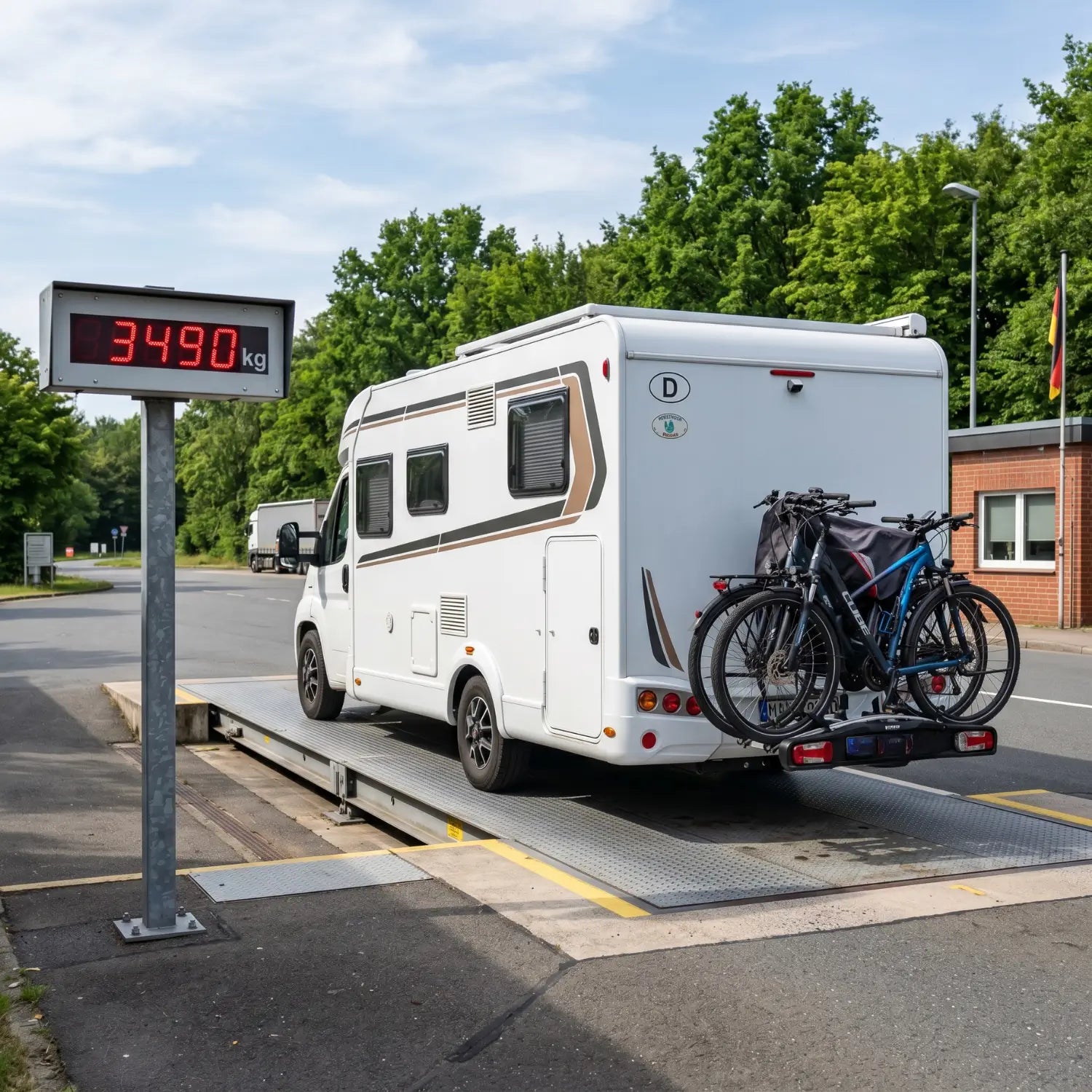
With a Category B driver's license, the 3.5 t motorhome is the classic. Practical, maneuverable, welcome everywhere. Only this class has a catch: the reserve when loading is smaller than you think when packing in many vehicles.
Two e-bikes, full supplies, camping furniture, a second gas bottle "just in case" and you're over it. And that's exactly what can become really unpleasant and expensive in Europe, because some countries say very quickly when overloaded: continue driving only when the weight is back in line.
In this article you get a clear overview:
- what really counts with weight
- how checks work
- what overloading can cost in typical travel countries
- and above all: how you save weight without sacrificing your self-sufficiency or comfort
Basic knowledge: What really counts with weight?
When it comes to overloading, it's not your feeling that decides, but the scale.
The permissible total weight, in short zGG, is the upper limit with which your motorhome can drive on the road. And everything counts in:
- Driver and passengers
- Luggage, food, clothing
- Gas
- Water
- Accessories and technology
Important: "Empty weight" does not mean that you are safely under 3.5 t on the road. As soon as people get in and you have your travel setup on board, the calculation looks completely different.
Not just zGG: Why axle load and weight distribution are crucial
Even if you are barely within the total weight, the axle load can become your problem.
The classic is the rear: rear garage full, plus a rack with two e-bikes. This not only puts a lot of weight in the vehicle, but it also sits in the worst possible place. This can mean:
- poorer driving behavior
- longer braking distances
- more stress in crosswinds
The simple rule of thumb is: heavy stuff as low as possible and as close to the axle as possible. And everything that goes to the rear deserves extra attention.
How does a weight check work?
Weight checks usually work similarly. This is what it often looks like in practice:
- You are waved out or directed to a control lane.
- The vehicle is weighed, depending on the country, mobile or stationary.
- If an exceedance is detected, fines and possibly additional measures are threatened.
What many underestimate: The fine is sometimes not the biggest pain. It gets really annoying when you have to reduce weight and are standing right on the roadside and wondering whether you have to drain water, reload things or store equipment somewhere.
What can it cost? Overview table for Germany and popular travel countries
The details differ depending on the individual case, measuring method and local practice. The table helps you as an orientation, where it becomes rather "unpleasant" and where it can quickly become "vacation-critical".
|
Country |
Typical logic and threshold |
Approximate costs for overloading |
What often happens additionally in practice |
|
Germany |
Often graduated sanctions, noticeable depending on the exceedance, often becomes relevant from more than 5 % |
approx. 10 to 235 € |
In case of severe overloading, continuing the journey can be linked to reloading |
|
Austria |
Considered strict, little leeway in practice with overloading, checks can be consistent |
approx. 85 to 5,000 € |
Continuing the journey can be prohibited until the weight is back in line, partly weighing costs are added |
|
Switzerland |
Clear administrative offense in certain areas, beyond that regular procedure possible |
approx. 100 to 250 CHF |
Often you have to reduce before continuing the journey, depending on the case further steps are possible |
|
Italy |
Often a tolerance up to 5 % is spoken of, after that it is sanctioned |
from approx. 42 € upwards |
Depending on the check, weight adjustment can be required, especially with a significant exceedance |
|
France |
Very strict, little tolerance |
approx. 135 to 750 € |
If you are significantly over, the vehicle can be impounded until the weight is right |
|
Spain |
Wide range, depending on classification and extent of overloading |
approx. 301 to 4,000 € |
Depending on the situation, continuing the journey can be restricted, especially with a significant excess |
The biggest weight eaters in the motorhome, and how you tackle them sensibly
If you want to save weight, it does little good to tweak small things, while you start with a half-full water tank and two heavy bikes at the rear.
Here are the big items that bring the most kilos in practice:
- Water, fresh water and wastewater
- Gas, bottles and fill level
- Bicycles, especially e-bikes, plus rack and accessories
- Camping furniture and awning, awning accessories
- Tools, spare parts, cables and everything that goes along "just in case"
And now the important part, which is often forgotten with technology: Yes, technology can bring weight. But it also brings you freedom. A good power supply, a properly dimensioned battery and a cleanly planned setup make travel more relaxed.
The trick is not "leaving technology out", but "consciously planning technology":
- What do you really need to support your way of traveling
- Which components deliver a lot of benefit at manageable weight
- And what is rather a wish list than everyday
With a well-thought-out system, self-sufficiency is possible, without your motorhome automatically becoming too heavy.
The best method: In a short time to a real weight and loading strategy
Weigh once correctly: Weigh your motorhome as you really drive off:
- People on board or realistically calculated
- Luggage and equipment inside
- Water level as at the start
A simple weight traffic light: Divide your equipment into three categories:
- Must go with: safety, duty, real travel foundation
- May go with: comfort, which you really use
- Can go out: rarely used, double present, heavy without benefit
Packing list with weights: If you have weighed roughly once, you only need to manage it later.
Practical tip: Work with fixed boxes. If every box has a place and you know what it weighs, packing suddenly becomes really easy.
Concrete tips: This is how you save weight without vacation frustration
Here come tips that have proven themselves in practice and bring the most kilos:
Water is the fastest lever, because it is on board in large quantities and because you can refill it almost everywhere on the road.
- Do not automatically start with a full tank.
- Take only as much water as you realistically need for the first stage.
- If you rather stand at campsites or pitches, you can refill much more relaxed as needed.
Gas is comfort, but two full bottles are quickly a decent package.
- Check your real consumption. Summer and winter are two worlds.
- If you cook a lot, then plan gas consciously, but strike out the habit reserve.
E-bikes, rack and rear relief
If overweight starts somewhere, it's often here:
- Calculate the complete package: bikes, rack, batteries, locks.
- Check if you transport unnecessary accessories on the bike.
- Avoid additionally heavy boxes at the very back, if bikes are already hanging at the back.
If you need the bikes at the rear, then that is absolutely okay. But then the rest of the loading must be all the more disciplined at the front and middle.
Camping furniture to trim light
The classic: Stable is good, but you don't carry the table every day over a mountain.
- Look at the table and chairs honestly. Many sets are significantly heavier than necessary.
- Take only what you really use.
- Awning only if it plays a real role in your travel everyday.
Kitchen and supplies reduce
Here often hides surprisingly much weight.
- Better buy drinks and heavy supplies at the destination or on the road.
- Double parts out: two pans, three pots, five cups.
- Travel focus instead of household kitchen: You need a functional basis, no full equipment.
Plan technology so that it brings freedom, but does not overcomplicate
Technology is not the enemy. Unplanned technology is the enemy.
- Define first your need: What do you really want to operate
- Dimension the battery and inverter accordingly, not "on suspicion maximum"
- Plan space and weight as a fixed boundary condition
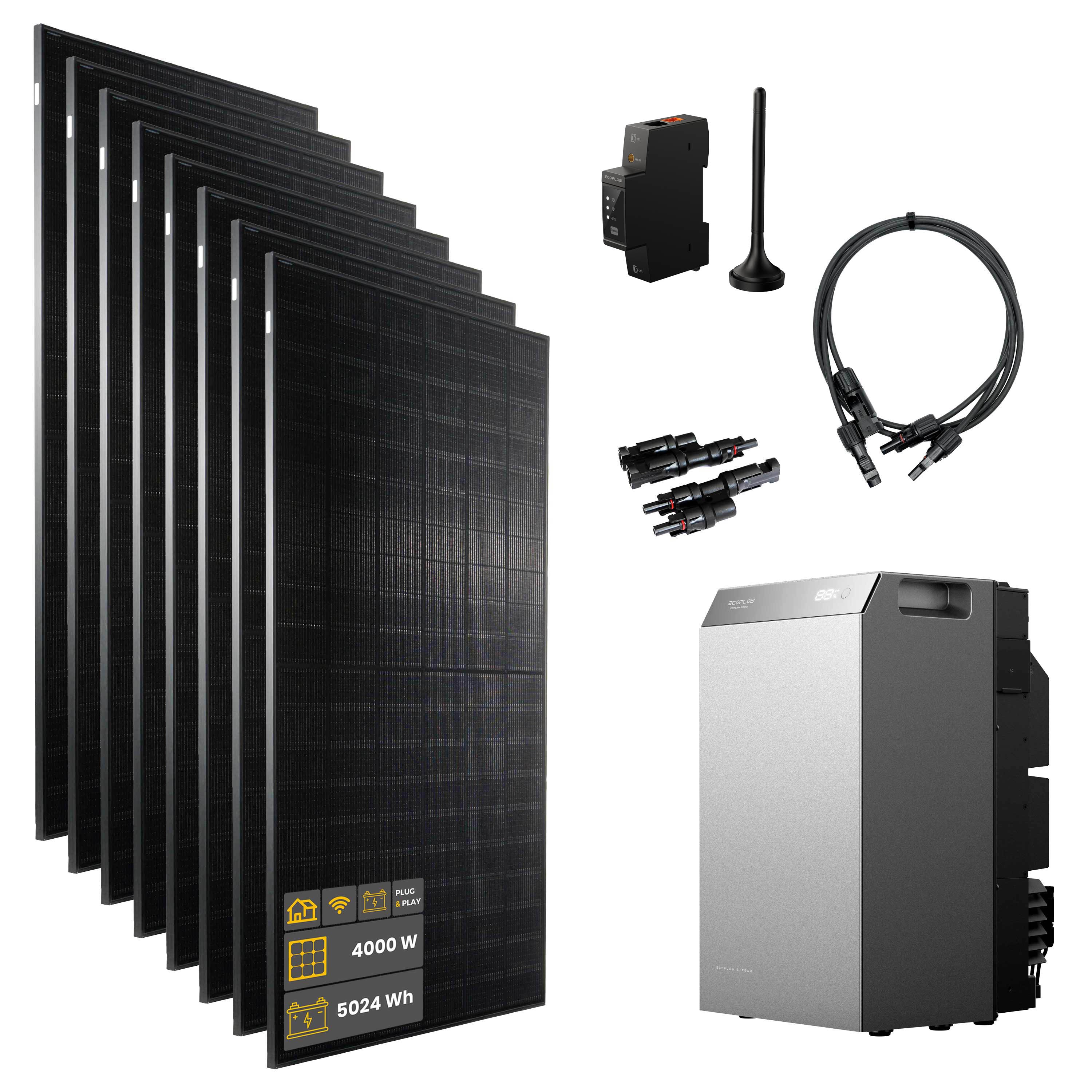
- So you can e.g. save a lot of weight by installing a lithium battery, instead of an AGM
- and SOLA Flex modules, instead of SOLA Frame on the roof.
If you do that cleanly, you get self-sufficiency without unnecessary kilos.
How you calculate your consumption correctly you find here: https://solarkontor.de/pages/solarrechner
And how you can save even more weight you learn here: https://solarkontor.de/blogs/ratgeber/gewicht-sparen-im-camper
Tools and spare parts: sensible, but only take the most important
A good basic stock is important. The rolling workshop is often only reassurance.
- Take tools with you that fit your vehicle and your typical problems.
- Strike out everything that you realistically cannot use, because you lack the parts, the time or the nerves.
Mini check before departure: This is how you are legally with high probability
- Weigh once or at least realistically calculate against
- Deliberately determine the water level
- Check the rear: what is really heavy at the back?
- Define a “Can Be Removed” box in case you need to reduce weight at short notice
- Heavy items should be placed low and towards the front, not at the rear
Ultimately, overloading at 3.5 t is rarely an issue you simply “tick off” with a minor fine. Much more often, it’s a question of whether you can continue driving immediately after an inspection or whether you first need to reduce weight. If you keep an eye on the major items—water, gas, bikes, furniture, and above all, their distribution in the vehicle—you’ve already solved most of the problem. And technology doesn’t have to be a weight burden: If you plan your power setup to suit your trip, you’ll get exactly the freedom you want without making your motorhome unnecessarily heavy. The result is simple, but worth its weight in gold: you’ll drive more relaxed, safer, and with significantly less risk on your next adventure.