

Power stations as an all-in-one solution in campers
Power stations have become one of the most popular power solutions for campers in recent years – and for good reason. They combine a battery, inverter, solar charge controller, and various connections in a single device. Whether you're only traveling for the weekend, want to work flexibly, or need a backup power source for emergencies, a power station can be an extremely practical addition to, or even an alternative to, the traditional onboard electrical system.
In this part of our component guide , you will learn who benefits from power stations, how they differ from permanently installed power systems, and what options you have for combining them with solar panels or shore power.
Who would benefit from a power station?
Power stations are particularly interesting for campers who are looking for a simple, portable, and immediately usable solution – without extensive installation or technical planning. They are ideal for:
- Weekend campers who want to operate lights, mobile phones, laptops or a cooler
- Vanlifers who work remotely and need electricity everywhere
- Travelers without a fixed electrical system (e.g., rental vehicles or micro-campers)
- Anyone who wants a backup system for the on-board battery
- Outdoor or off-road travelers who want to use energy outside the vehicle
Thanks to their modular design, you can take power stations anywhere – whether to your tent, to the beach, into your awning or as an emergency power source in your house.
Advantages of power stations – compact, flexible & plug-and-play
Power stations are true all-rounders. They offer:
- Plug & Play : No installation, no wiring, just switch it on.
- Compactness : everything in one device – battery, inverter, controller, connections
- Mobility : portable, easy to store, ideal for flexible use
- Versatility : 12V connections, USB/USB-C, AC 230V – depending on the model
- Safety : integrated protective functions
- Easy charging : with solar panels, via shore power, via the 12V cigarette lighter in the car or with the alternator charger via the alternator.
For many smaller or medium-sized setups, a power station can completely replace a classic on-board electrical system.
Differences from the classic electrical system
A permanently installed electrical system consists of many individual components: battery, solar charge controller, charge booster, inverter, fuses, cable system – all permanently connected.
A power station combines all these components in one device. However, a power station does not always replace a complete vehicle electrical system – especially with very high power outputs (e.g., induction, large inverters, air conditioners), many models reach their limits.
Combination with solar modules
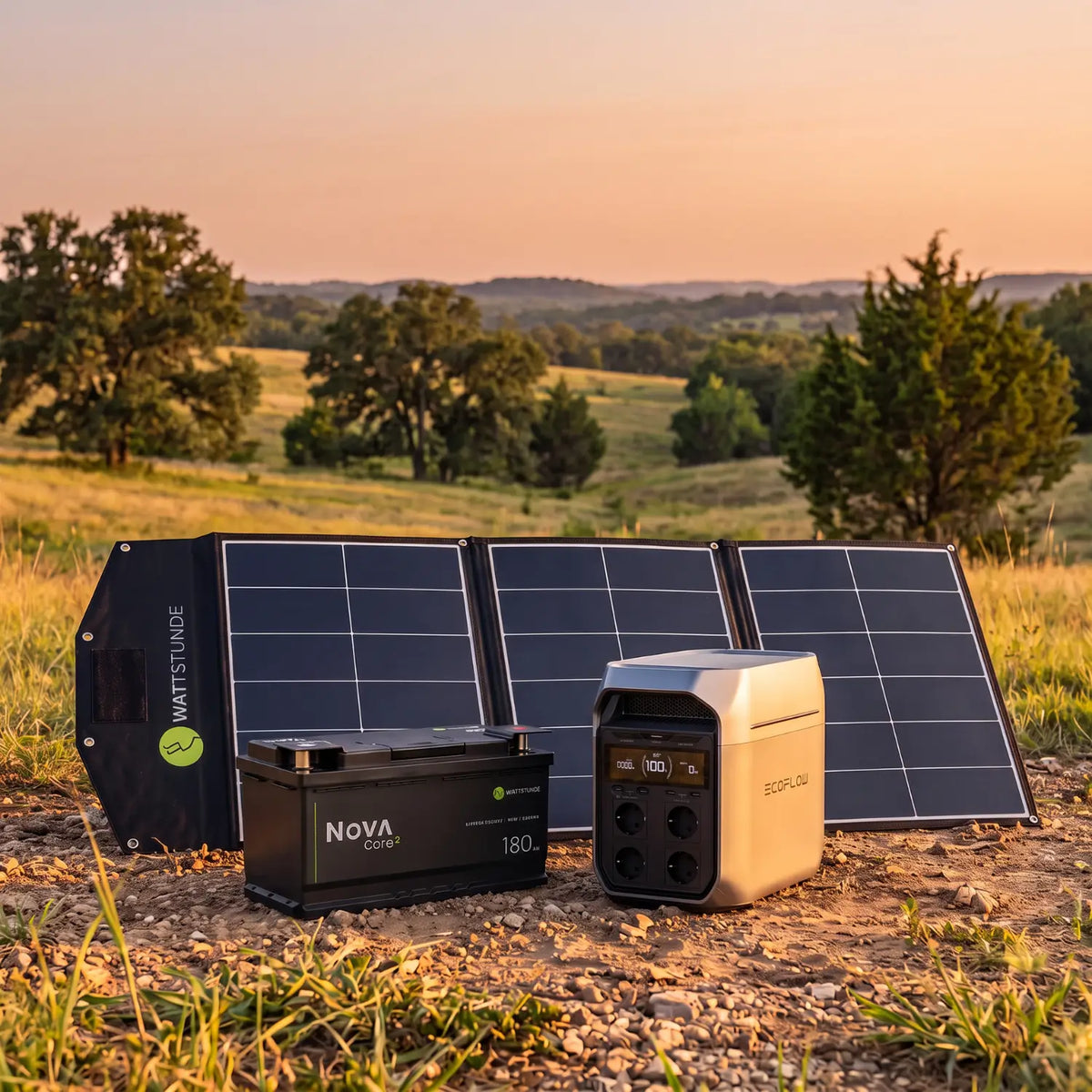
Power stations can be used very easily with solar panels – whether solar bag, solar suitcase or framed panels. Many models have Anderson, XT60, DC or MC4 compatible connectors .
This makes it very easy for you to use solar power on the go: You take the appropriate adapter cable, plug in your solar panel – and the power station takes care of the rest.
This allows you to generate electricity flexibly – without installation, without additional controllers, and without permanently installed solar technology. This is especially practical for travelers who camp off-grid, are frequently on the go, or don't have space for a rooftop system.
💡 Tip : Many campers deliberately use a power station to supplement their vehicle's electrical system. They charge small devices like cell phones, cameras, drones, or laptops directly from the power station while on the go. This relieves the strain on the vehicle's battery, and you always have a mobile power reserve that you can use independently of the vehicle.
Power stations as backup or additional systems
Even if you have a classic electrical system, a power station can be a useful addition:
- as a secondary power system in case of failures
- as a power source for laptop & camera outside the camper
- as an emergency power reserve in winter
- as a flexible source that you can take anywhere
Many campers use them, for example, to remain mobile at festivals or on rest days away from the vehicle.
Reliable shore power via CEE – also with power station
With a CEE power supply cable with RCD protection (from WATTSTUNDE) you can even use your power station to charge your auxiliary battery or operate devices in the vehicle – safely and in accordance with standards.
Further information about the CEE power supply cable with residual current device (RCD) protection can be found here : https://solarkontor.de/blogs/ratgeber/einspeisung-powerstation-ins-wohnmobil
EcoFlow Powerstations at a glance – from small to large
To help you quickly assess which EcoFlow power station suits your everyday camper needs, you'll find a compact overview of the current models here. This way, you can see at a glance which model is suitable for which application.
|
Model |
capacity |
Power (AC) |
Ideal for… |
|
EcoFlow TRIAL 200 DC |
192 Wh |
100 W |
Ultra-compact solutions, mobile phone, camera, lightweight consumer products |
|
EcoFlow TRIAL 300 DC |
288 Wh |
100 W |
Day trips, smaller consumers, very small setup |
|
EcoFlow RIVER 3 |
256 Wh |
300 W |
Short trips, mobile phone, camera, small devices |
|
EcoFlow RIVER 3 Plus |
512 Wh |
300 W |
Weekends, laptop, small cooler |
|
EcoFlow RIVER 3 Plus Wireless |
512 Wh |
300 W |
Like the RIVER 3 Plus, plus wireless charging |
|
EcoFlow RIVER 3 Max |
768 Wh |
500 W |
More self-sufficiency, laptop work, cooler |
|
EcoFlow RIVER 3 Max Plus |
768 Wh |
500 W |
Higher daily consumption, mobile working |
|
EcoFlow RIVER 3 Max Plus Wireless |
768 Wh |
500 W |
Like Max Plus, plus wireless charging |
|
EcoFlow RIVER 3 UPS |
512 Wh |
300 W |
Mobile UPS use, work equipment, sensitive electronics |
|
EcoFlow DELTA 3 |
1,024 Wh |
1,800 W |
Van life, refrigerator, coffee machine, e-bike shop |
|
EcoFlow DELTA 3 – 1500W |
1,024 Wh |
1,500 W |
Higher continuous loads, mobile working, tools |
|
EcoFlow DELTA 3 Max |
2,048 Wh |
2400 W |
Large setups, self-sufficient travel, high consumption |
|
EcoFlow DELTA Pro 3 |
4,096 Wh |
3,600 W |
Large vehicles, off-road, long periods of self-sufficiency, emergency power supply |
💡 Note : The models differ primarily in capacity and continuous power output – so it's important that you know your actual needs. You can easily find out how much energy you really need with our solar calculator: https://solarkontor.de/pages/solarrechner
Conclusion & Outlook
Power stations are an extremely practical way to reliably use electricity in a campervan – without installation, complexity, or risk. Whether as the main system for small campers or as a supplement to a larger onboard electrical system, they offer maximum flexibility and true independence.
In the next article of our component guide, we will conclude the series and show you how to combine all the components into a functioning overall system.