


A reliable fuel gauge might sound like a luxury at first, but in practice, it makes everyday life much easier. Whether it's fresh water, grey water, waste water, or diesel: if you don't know how full the tank really is, every trip quickly becomes unnecessarily complicated. Many classic fuel sensors work with a float in the tank, probes, or capacitive rods. And that's exactly where the typical problems begin: floats can get stuck, probes can drift, and foam can confuse some sensors.
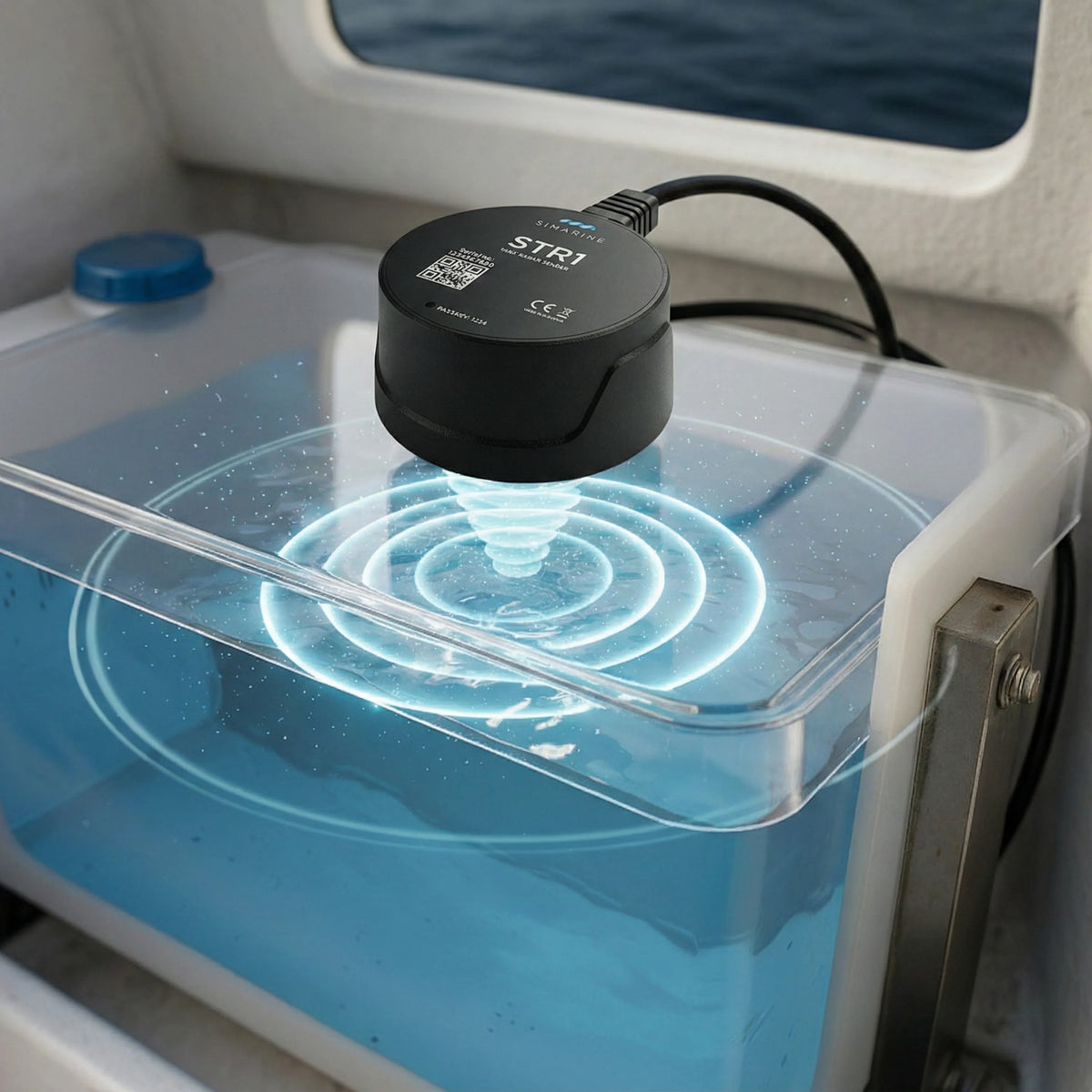
Simarine takes a different approach with the STR tank sensor. Instead of touching the tank contents, the sensor measures from above through the tank lid using micro radar. The result is a tank measurement that remains stable and uses no moving parts. According to the manufacturer, the STR1 and STR2 can measure tank heights from 150 to 2000 mm and do so without any contact with the liquid. This is particularly exciting for tanks where you don't want to deal with maintenance, sealing, or leaks.
What exactly is the Simarine STR tank sensor?
The Simarine STR is a radar tank sensor that is mounted on the outside of the tank lid. The sensor measures the fill level without a probe extending into the tank and without a float having to operate inside. This significantly reduces sources of error, because neither dirt, fuel residue, nor deposits can mechanically affect the sensor.
Simarine offers two variants that are based on the same radar technology but differ in their output signal.
STR1: Analog, universal
The STR1 is the variant if you have an existing analog display instrument or want to connect the sensor to a system that expects analog signals. According to Simarine, the STR1 provides several standards, including resistance outputs and a voltage output. It can also be configured and updated via Bluetooth in the Simarine Connect app.
STR2: NMEA 2000 for modern networks
The STR2 is aimed at setups with an NMEA 2000 network, for example on a boat with a chartplotter or MFD. According to Simarine, the STR2 sends the NMEA 2000 Fluid Level data set PGN 127505, although certification is still pending. The STR2 can also be set up via Bluetooth using the Simarine Connect app and can receive firmware updates. Important: Simarine expressly states that the STR2 is not compatible with Simarine PICO.
Why radar makes so much sense for tank measurement
Classic solutions often don't fail immediately, but gradually. First, the display becomes inaccurate, then it starts to jump, and eventually, it gets stuck.
Simarine counters the radar principle with concrete advantages:
- Floats can get stuck and are mechanical wear parts
- Capacitive probes can drift over time, for example depending on the liquid and contamination
- Ultrasound can be confused by foam
- Radar measures non-contact and needs no moving parts
The STR sensor sits on top of the tank lid and measures through non-metallic tank lids. This eliminates not only maintenance, but also the risk of creating a leak during installation.
What liquids can the STR measure?
The sensor is designed for different tank types, including fresh water, grey water, waste water, and fuel. So you don't have to choose a different sensor type for every liquid. This simplifies the selection, especially if you have multiple tanks in the vehicle or boat.
Installation: Without drilling into the tank
If you have ever installed a tank sensor, you know the moment when you briefly swallow hard: drill a hole, seal it, and hope that everything stays sealed in the long term. Simarine positions the STR exactly as an alternative to this.
The sensor is attached to the outside of the tank lid using a peel-and-stick mount. You mount it on top, run the cabling, and perform the commissioning via the app. For metal tanks, a special adapter is recommended, the S5 metal tank adapter, because metal cannot be measured through.
The minimum tank height of 150 mm does not mean that the sensor only "starts to see" from a distance of 150 mm. It refers to the total supported tank height. Directly at the sensor surface, there is only a small near-field zone of approximately 10 mm, which is described as a dead zone.
Setup and calibration via the Simarine Connect app
The STR is paired with the Simarine Connect app via Bluetooth. Through it, you can set up the sensor, name it, set units, and perform firmware updates. A strong feature is the calibration for irregular tank shapes: you can set up to 100 calibration points. This is perfect if your tank is not rectangular, but angled, round, or built in steps.
In practice, that is exactly the difference between "roughly half full" and "I know pretty exactly how many liters are still in there".
Technical specifications you should know
So you can assess whether the sensor fits your setup, here are the most important data:
Table
|
Feature |
STR1 |
STR2 |
|
Measurement principle |
Micro radar, non-contact |
Micro radar, non-contact |
|
Supported tank height |
150 to 2000 mm |
150 to 2000 mm |
|
Resolution |
approx. 7 mm |
approx. 7 mm |
|
Update Rate |
1 Hz |
0.5 Hz on the NMEA 2000 bus |
|
Power supply |
8 to 35 V DC |
8 to 35 V DC |
|
Protection rating |
IP67 splash-proof |
IP67 splash-proof |
|
App |
Simarine Connect |
Simarine Connect |
|
Warranty |
three years |
three years |
The typical power consumption is approximately 14 to 20 mA at 12 V. This is so low that it barely makes a difference in everyday use.
STR1 or STR2: Which variant is right for you?
The decision depends almost entirely on how you want to display the fill level.
STR1 is suitable for the following applications
You have an analog display instrument or a system that expects a resistance signal or 0 to 5 V. Then STR1 is the uncomplicated choice. Simarine also describes STR1 as a replacement for classic sensors without necessarily having to mechanically remove the old sensor. You simply disconnect it and use the STR.
STR2 is ideal for the following cases
You operate an NMEA 2000 network and want to see the tank level directly on a compatible display, for example on a chartplotter. Then the STR2 is designed for you. Important here: STR2 is not compatible with Simarine PICO because it runs purely over NMEA 2000.
Conclusion: The Simarine tank sensor is a clever solution for anyone who wants peace of mind in the system
If you have had enough of inaccurate tank gauges that jump or start acting up again after a season, then a radar tank sensor like the Simarine STR is really interesting. No moving parts, no probe in the tank, no drilling below the liquid line, and on top of that, an app with which you can set everything up properly and even calibrate it precisely.
Especially for motorhomes, vans, boats, and off-grid systems, this is an upgrade that doesn't feel like a gimmick, but like a real everyday convenience.