
If you're hoping for a precise number of days, months, or charging cycles, we're afraid we have to disappoint you. How long your power station actually lasts depends entirely on how you use it – and, of course, on which model you have.
But before we go into detail, let's first clarify: What exactly is a power station?
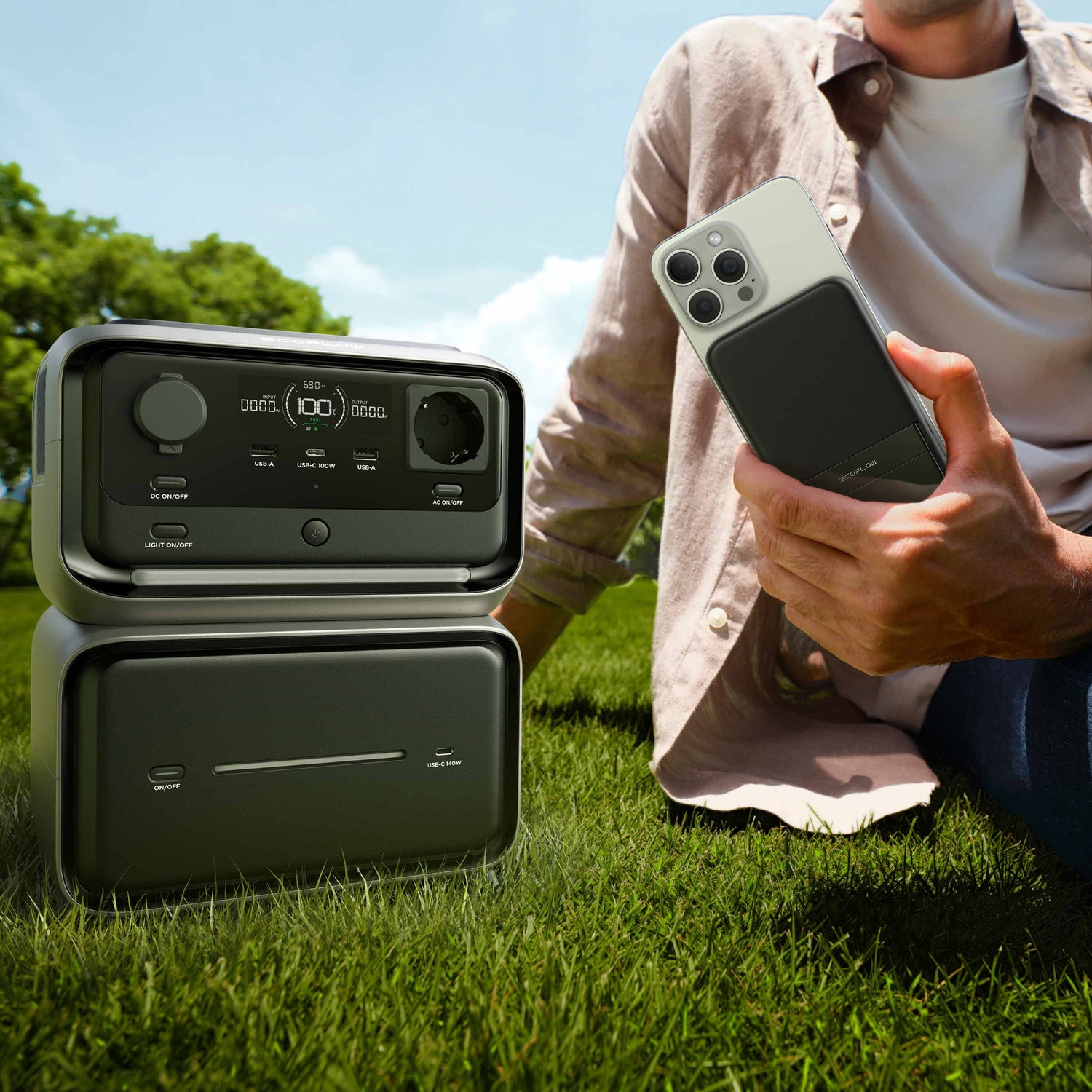
Essentially, a power station is nothing more than a battery that you can charge using solar energy, for example. It can then be used to power computers, smartphones, or even household appliances – both indoors and outdoors.
Unlike a conventional generator, a power station is significantly more flexible: A generator is loud, can only be used outdoors, and is anything but resource-efficient , maintenance-intensive and cannot be combined with solar modules.
But what does all this have to do with the Lifespan of your power station What to do? That's exactly what we're going to look at now!
Quite simply: The lifespan of a power station is determined in Charging cycles Measured – one charging cycle corresponds to a complete charging and discharging. And this is exactly where you come in. You The key factor is how you use your power station, which directly impacts how long it will reliably supply you with power.
That's why we have for you 6 ultimate tips Compiled with tips that can noticeably extend the lifespan of your power station! 
Tip No. 1: Charge your power station correctly
Ideally, charge your power station between 20% and 80%. Fully charging or completely discharging it is not optimal – this protects the battery and extends its lifespan.
Tip No. 2: Pay attention to the correct temperature
Extreme temperatures are detrimental to your power station. The optimal temperature range is 20°C to 30°C. If it's outdoors, keep it in the shade and away from direct sunlight.
Tip No. 3: Use the correct cables
It's best to use the original cables. If these are defective, make sure the voltage (voltage) matches the device to avoid overheating or damage.
Tip No. 4: Calibrate regularly
You can calibrate your power station every 4-6 weeks: completely discharge it and then fully recharge it. This allows it to remember its zero point and display more precise charge values.
Tip No. 5: How to properly prepare for hibernation
In winter, your power station shouldn't just sit in a cold van or camper. It's better to store it in a storage room, fully charge it beforehand, and check the charge level every few weeks (at least half full). If possible, use it occasionally during the winter as well.
Tip No. 6: Charge with solar energy
Gentle charging is better than fast charging. Solar energy is ideal: resource-efficient , gentle on the battery, and extends its lifespan because charging is slower.
With these 6 ultimate tips, you'll get the most out of your power station. As mentioned earlier, there's unfortunately no general statement about lifespan. Nevertheless, we've looked at the charging cycles of power stations from manufacturers Bluetti, Jackery, and EcoFlow and compiled a handy overview for you:
| Power station | Charging cycle |
|---|---|
| Jackery Explorer 2000 | 1,000 charging cycles |
| Jackery Explorer 1000 Pro | 1,000 charging cycles |
| Jackery Explorer 1000 | 500 charging cycles |
| Jackery Explorer 500 | 500 charging cycles |
| Jackery Explorer 240 | 500 charging cycles |
| Bluetti AC50S | 1,000 charging cycles |
| Bluetti AC200P | 3,500 charging cycles |
| Bluetti AC200 MAX | 3,500 charging cycles |
| Bluetti EB55 | 2,500 charging cycles |
| Bluetti EB70 | 2,500 charging cycles |
| Ecoflow River (Mini) | 500 charging cycles |
| Ecoflow River | 500 charging cycles |
| Ecoflow River (Max) | 500 charging cycles |
| Ecoflow River (Pro) | 800 charging cycles |
| Ecoflow River 2 Max | 3,000 charging cycles |
| Ecoflow River 2 Pro | 3,000 charging cycles |
| Ecoflow River 3 | 3,000 charging cycles |
| Ecoflow River 3 Plus | 3,000 charging cycles |
| Ecoflow River 3 (all other models) | 3,000 charging cycles |
| Ecoflow Delta | 800 charging cycles |
| Ecoflow Delta 2 | 3,000 charging cycles |
| Ecoflow Delta (Max) | 800 charging cycles |
| Ecoflow Delta (Pro) | 3,500 charging cycles |
| Ecoflow Delta 2 Max | 3,000 charging cycles |
| Ecoflow Delta 3 | 4,000 charging cycles |
| Ecoflow Delta 3 1500 | 3,000 charging cycles |
| Ecoflow Delta Pro 3 | 4,000 charging cycles |