


Victron battery management system VE.Bus BMS
Intelligentes Batterie Management System VE.Bus von Victron
- Schützt 12, 24 & 36 V Batteriesysteme
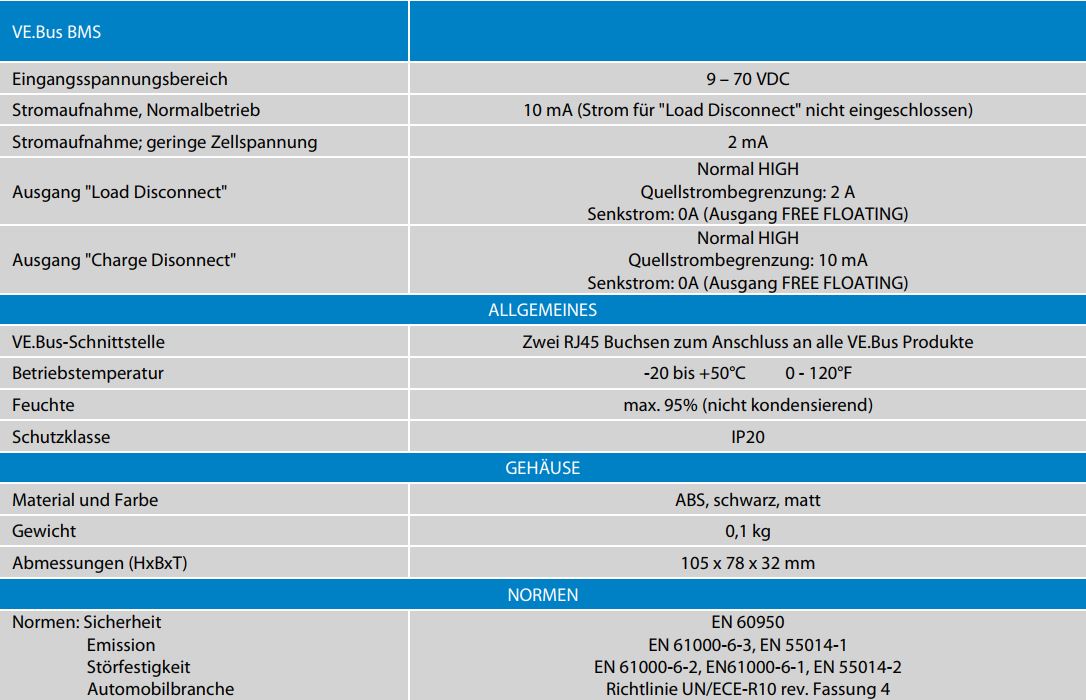
- Betriebsspannungsbereich: 9 - 70V DC
- Zentrale Steuereinheit (BMS) für ein Lithium-Ionen Batteriesystem
- wird mit Cyrix-Li-Load/Charge gekoppelt
- individuelle Systemkonfiguration möglich
Tax included. Shipping calculated at checkout
Your legal guarantee rights

Product description
Battery Management System VE.Bus BMS from Victron
Protects every single cell of a lithium iron phosphate (LiFePO4 or LFP) battery
Every single cell of a LiFePO4 battery must be protected against overvoltage, undervoltage and overtemperature.
Victron LiFePO4 batteries feature built-in cell balancing, temperature, and voltage control (hence the acronym BTV). They connect to the VE.Bus BMS via two M8 circular connector cable sets.
The BTVs of multiple batteries can be chained together. Up to ten batteries can be connected in parallel and up to four batteries can be connected in series (BTVs are simply chained together), creating a 48 V battery bank with up to 3000 Ah. For further details, please refer to the Victron LiFePO4 battery technical documentation.
Tasks of the BMS:
- Switching off or disconnecting loads in the event of an imminent undervoltage
- Reducing the charging current in case of imminent cell overvoltage or overtemperature (only for VE.Bus products)
- Switching off or disconnecting the battery chargers in the event of an imminent cell overvoltage or overtemperature.
Overview of a battery system
You can put together your battery system individually.
Three components are used to control energy flows:
-
VE.Bus BMS
is the central control unit. The battery data cables are connected so that the BMS can forward the read information for the appropriate switching commands. There are also numerous other communication ports that can be used to control, for example, MultiPlus inverters or high-load relays. -
Cyrix Li Load
This device is connected between the load and the power supply (the batteries). If the battery runs low (low voltage alarm), the loads are disconnected from the battery. -
Cyrix Li Charge
The Charge Li device is located between the batteries and chargers (=charge), such as the solar panel or alternator. If the energy source provides too much power (overvoltage signal), the charger is disconnected.
Technical data
Product details & downloads
Manufacturer information and, if applicable, the responsible person:
Victron Energy
The Paal 35
1351 JG Almere
Email: sales@victronenergy.com
Homepage: https://www.victronenergy.com


Advice & Contact
Questions about the article?
If you have any further questions about the product or would like to contact us in general, please click the button and send us a message. We look forward to hearing from you!
GET ADVICE NOW