
Inverter – Generate 230 volts in a motorhome
If you want to cook, work, or charge your devices just as comfortably in your campervan without shore power as you do at home, there's no way around an inverter . It converts the 12V DC from your leisure battery into standard 230V AC – opening up a whole new world of possibilities. Many everyday devices only work with mains power: coffee maker, kettle, laptop power adapter, monitor, vacuum cleaner, chargers for cameras or drones – all of this would be impossible without an inverter.
This article explains why an inverter is essential for many campers, what types of devices are available, how to choose the right power output, and what you absolutely must consider during installation.
Why do you need an inverter?
Your campervan typically runs on a 12V DC electrical system . This is ideal for many appliances such as LED lights, water pumps, USB charging ports, and compressor refrigerators. However, as soon as you want to use household appliances or those requiring higher power, the 12V system reaches its limits.
Typical 230V devices include, for example:
- Coffee machines (portafilter machines, capsule machines)
- Kettle or toaster
- Hairdryer or hair straightener
- Induction cooktops
- Notebook power supplies or monitors
- Chargers for drones, cameras or tools
- vacuum cleaners or power tools
An inverter converts the electricity from your battery into standard household alternating current – allowing you to use almost all the appliances you use at home while on the road. For full-time travelers, van workers, or anyone who wants to cook independently of gas, an inverter is therefore a real convenience upgrade.
Inverter types: Modified vs. Pure sine wave
Basically, there are two types of inverters – and the differences are greater than you might initially think.
Modified sine wave
These models generate a simplified, angular version of the normal sine wave. They are inexpensive and work well for simple devices like lamps, fans, or very basic chargers. However, there are clear limitations: many electronic devices are sensitive to the unstable voltage.
Disadvantages:
- Unsuitable for laptops, coffee machines, modern chargers or devices with electronics.
- Higher risk of devices running unevenly or being damaged.
Pure sine wave
Pure sine wave inverters produce power quality similar to that from a household wall socket. This makes them suitable for almost all devices – including sensitive electronics.
Advantages:
- Universally applicable
- Safe for all consumers
- Stable operation even under high load
Recommendation: For motorhomes, a pure sine wave inverter is almost always the right choice.
The right power output: How powerful does your inverter need to be?
The inverter's power output should be compatible with your devices. This includes not only the power consumption during normal operation, but also so-called inrush currents – short power peaks that many devices require when starting up.
Typical performance areas
- 300 – 600 W : Laptop, camera batteries, small appliances, e-bike charger
- 1,000 – 1,500 W : Coffee maker, kettle, toaster, microwave
- 2,000 – 3,000 W : Induction hob, tools
What are inrush currents?
A device can draw two to five times its normal power briefly when switched on.
Example: A hairdryer with 1,200 W may require up to 2,000 W at startup.
If the inverter cannot supply these peaks, it shuts down or the device doesn't start at all.
💡 Tip: When choosing, pay attention to the continuous power output AND peak power output of the inverter.
Can multiple inverters be used?
Yes, that's technically possible – but with limitations. Many campers use a small, energy-efficient inverter (e.g., 300 W) for their laptop or camera, and a large one (e.g., 2,000 W) for their kitchen or tools.
To ensure this works reliably:
- Never connect two inverters to the same circuit (exceptions exist for some Victron products).
- Use separate power outlet circuits or
- Use a switch or feed-in logic and
- Ensure that only one inverter is actively feeding power into the vehicle's electrical system at any given time.
For many setups, a high-performance inverter with good efficiency is the better choice – simple, clean, and safe. However, be sure to pay close attention to the inverter's own power consumption.
Combination devices: Inverter with charger & priority switching
Some inverters are available as so-called combination devices . These combine:
- inverter
- Battery charger
- Priority switching for shore power
Not all combination devices have all three functions. There are also inverters with two of the three possible functions. As soon as shore power is connected, the device automatically switches over and charges the battery – the inverter remains in the background. Ideal for anyone who frequently switches between off-grid operation and camping.
Installation & Safety – What you absolutely must pay attention to
An inverter operates with high currents. Therefore, proper installation is crucial for safety and efficiency.
Key points:
- Mount close to the battery to avoid voltage losses and to keep cable cross-sections as small as possible.
- Use high-quality, sufficiently thick battery cables
- Install the fuse as close to the battery as possible.
- Mount inverters with adequate ventilation – heat is an energy and safety killer.
- Never use extension cables with a thin cross-section for permanent installations.
When installed correctly, the inverter ensures that you can work, cook and live safely and comfortably in your camper.
Product recommendations
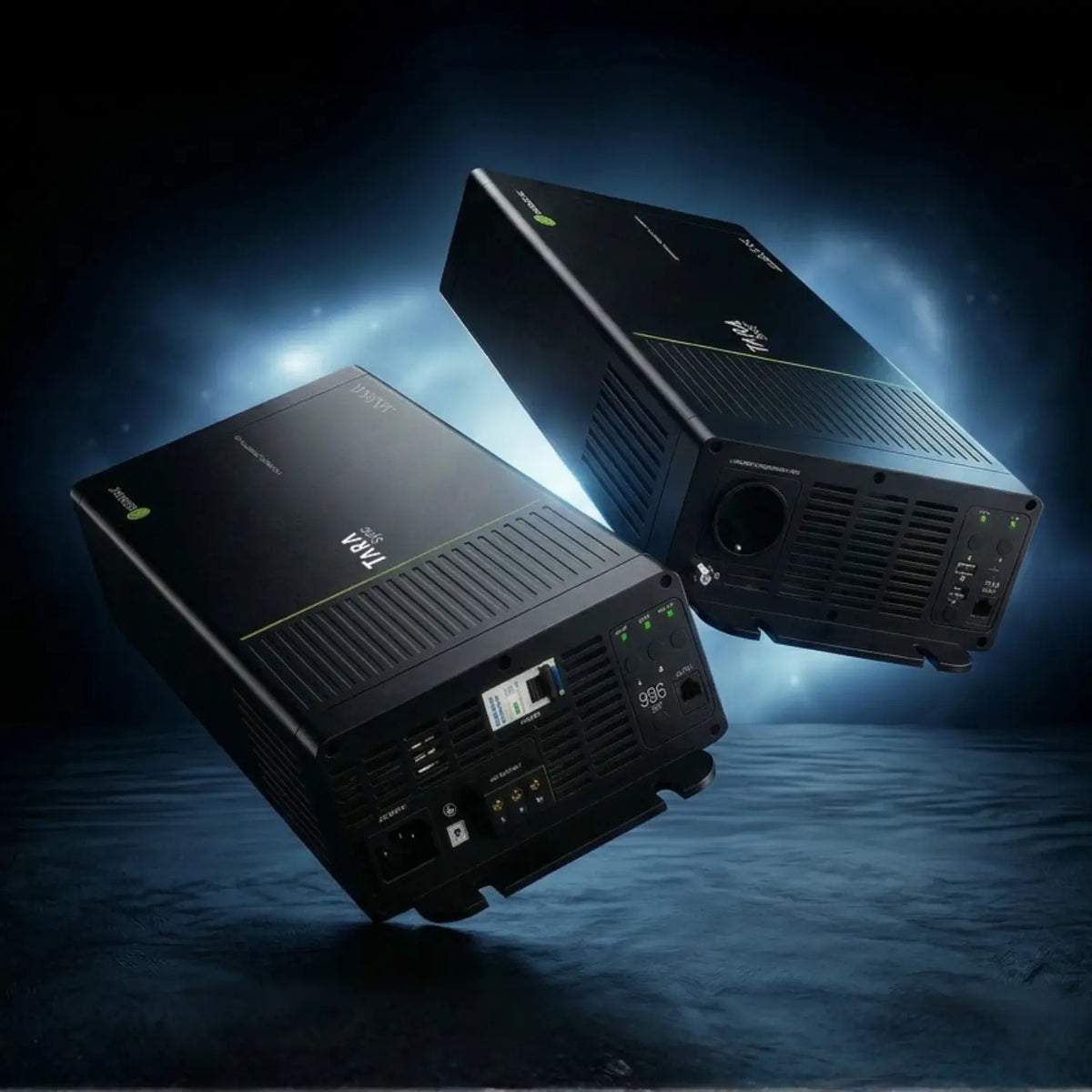
Depending on the application, different devices may be suitable. The WATTSTUNDE TARA Sync inverters are particularly interesting; they are available in several power classes and offer a reliable and high-quality power supply with their pure sine wave output.
WATTSTUNDE TARA Sync 800 W – Ideal for small appliances such as laptops, camera batteries, e-bike batteries, or lightweight kitchen appliances. Compact, efficient, and perfect for travelers who only occasionally need 230 V.
WATTSTUNDE TARA Sync 1500 W – The perfect mid-range power bank for coffee makers, kettles, microwaves, toasters, and other typical household appliances. Powerful enough for everyday use in a camper.
WATTSTUNDE TARA Sync 2200 W – For those who need real power: for example, for induction cooktops or tools. High continuous power, strong peak power, and ideal for self-sufficient setups.
WATTSTUNDE TARA Sync Remote Control – A practical accessory that allows you to conveniently switch your inverter on and off from your living area. Especially useful if the inverter is well hidden or installed low down.
This means the TARA Sync series covers almost all application scenarios in the camper – from compact notebook chargers to fully-fledged kitchen appliances.
Conclusion & Outlook
An inverter is the key component if you want to use standard household appliances in your camper. It extends your 12V system with convenient, reliable power, allowing you to cook, work, and charge on the go – almost like at home. Whether you choose a small inverter or a powerful one like the WATTSTUNDE TARA Sync 2200W, the crucial factor is that the power output, installation, and safety features are compatible with your setup and battery.
In the next article of our Component Guide series, we will focus on power stations – compact all-in-one solutions that combine inverter, battery and solar charge controller in one device and are particularly interesting for beginners and flexible setups.